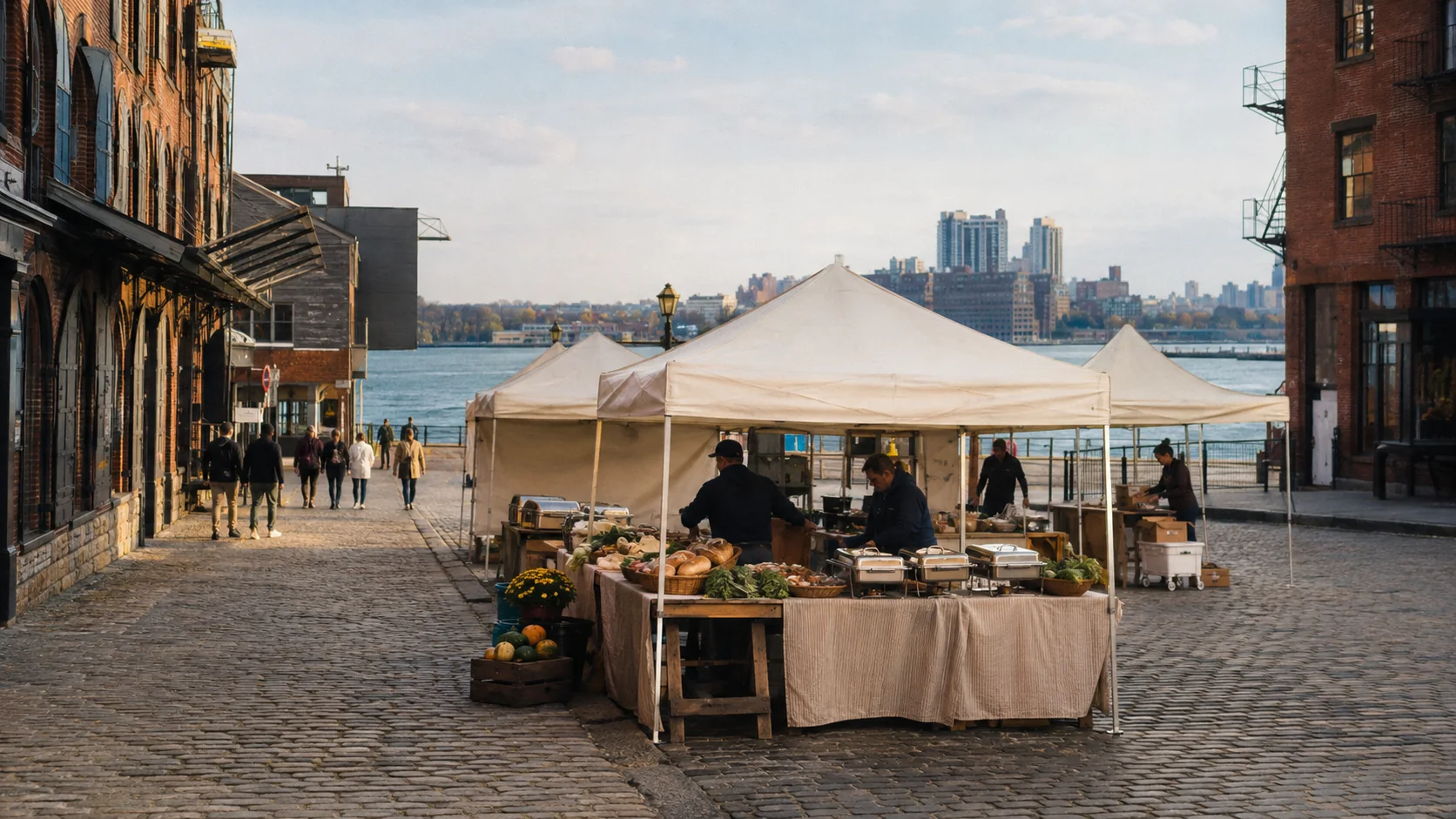
The Seaport is good at holding two versions of New York at once. One is all open sky, river light, brick streets, and buildings that appear to remember the port. The other is built from reservations, branded events, destination shopping, and a waterfront carefully arranged for an audience.
From October 15 through October 18, 2026, the New York City Wine and Food Festival will add a third version: a dense, ticketed food weekend with more than 50 events across its official program. The festival includes large tastings, chef demonstrations, dinners, cocktail events, and FoodieCon. Its arrival will not simply fill rooms. It will change the circulation of the district.
This is a researched preview, not a Field Signal review. Borough Signal has not attended the 2026 festival. We are looking at what the official program means for the neighborhood around it and how visitors can plan without allowing a four-day event to flatten the Seaport into a backdrop.
A festival crowd does not move like an office crowd
Lower Manhattan understands waves of people. Weekday commuters arrive with purpose and leave on familiar routes. Tour groups gather around landmarks. Weekend visitors drift toward the river. A festival crowd behaves differently because many people share the same timed destination.
That creates pressure before and after events. Sidewalks become waiting areas. Rideshare pickups compete with delivery traffic. Restaurants outside the official program may receive sudden demand, particularly when people decide they want one more drink or something less elaborate after a tasting.
The Seaport’s narrow streets make this concentration visible. That can feel energetic, but it can also turn a short walk into a slow one. Anyone attending a timed event should build in extra travel time and avoid assuming that a downtown address means every venue is steps from the same subway exit.
The river is not decoration
Food festivals are designed to focus attention inward, toward the plate, the stage, the chef, or the branded tasting table. The Seaport keeps pulling the eye outward. The East River, Brooklyn skyline, bridges, ferries, and changing weather remain present.
That waterfront location is part of the appeal, but it should not be confused with proof that every event will feel relaxed. Large tastings can be crowded. Popular stations create lines. October weather can change the comfort of moving between indoor and outdoor spaces.
Check the exact venue and format for each ticket. A seated dinner requires different preparation from a walk-around tasting. A daytime event may allow room for a long waterfront walk, while an evening schedule might send everyone toward the same exits at once.
More than 50 events is not a challenge
Festival marketing often turns abundance into pressure. The number of events becomes a measure of importance, and visitors begin planning as if missing a session means failing the weekend.
That is the fastest route to an expensive blur. Choose based on format, not only names. If you enjoy hearing a chef explain technique, a demonstration may offer more than a crowded tasting. If conversation matters, a smaller dinner could justify its higher price better than a large event. If you want to discover unfamiliar food, read the participant list rather than following the longest line.
One strong event and an unhurried evening downtown can be a better use of time than stacking tickets until the schedule becomes work.
The neighborhood has its own appetite
The Seaport is not an empty events district. It contains restaurants, bars, markets, retail spaces, offices, residences, historic fabric, and public waterfront routes. Some businesses will benefit from the festival crowd. Others may be harder to reach. Regular customers may decide to stay away for the weekend.
Visitors can support the area without forcing every meal into the official program. A coffee before an afternoon session or breakfast the following morning spreads attention beyond the festival gates. Check current hours and reservation policies directly. Do not assume a restaurant has space because it appears outside the event schedule.
It is equally important not to describe nearby businesses as undiscovered simply because they are new to a visitor. The Seaport has been watched, marketed, criticized, rebuilt, flooded, and reimagined many times. Its history is not a garnish for a food weekend.
Cost changes the meaning of the weekend
NYCWFF tickets vary widely by event, and official terms can include age restrictions, alcohol rules, and purchase conditions. The price of a ticket is not the full cost. Add transportation, food outside the event, service charges where applicable, and the possibility that a large tasting still leaves you wanting a quiet meal.
Read what the ticket includes. Look for start and end times, seating details, tasting format, and refund language. If alcohol is central to an event, arrange the return trip before arriving. Some festival programming is all ages, while other events require guests to be 21 or older. The individual listing controls.
Value is personal, but clarity is not. A useful guide should help readers understand what they are buying rather than repeat the excitement of the sales page.
Food culture is larger than celebrity
Large festivals use recognizable names because recognition sells tickets. Those appearances can be entertaining and meaningful. They should not become the only measure of the city’s food culture.
New York eating is shaped daily by line cooks, servers, bakers, dishwashers, small owners, market vendors, delivery workers, and cooks whose names never appear above a demonstration stage. The festival can celebrate food while still representing only one highly produced slice of that ecosystem.
The best version of the weekend makes room for both truths. A major chef event can be exciting. A simple meal outside the festival can carry more of the city’s actual rhythm.
Planning the Seaport without losing the Seaport
Start with the official NYCWFF listing and confirm the 2026 date, venue, age requirement, and ticket terms for your chosen event. Map the route from the subway or ferry. Add at least 30 minutes if you are unfamiliar with the district. Wear shoes that can handle cobblestones and standing. Check the weather.
Then leave one part of the visit unscheduled. Walk toward the water. Notice which buildings sit behind the festival signs. Watch the ferries cross. If the event was worth the price, let it remain the center of the day. If it was not, the neighborhood may still offer a reason the trip mattered.
The Seaport is about to get hungry, but it will not be hungry in only one way. Some people will arrive for a chef. Some will work the event. Some will be trying to get home through the crowd. A good city story sees all of them.
PRIMARY SOURCENYCWFF events ↗
See something that needs attention? Send a correction. We review factual notes and attach meaningful updates to the article.