The easiest US Open mistake happens after the match. You follow thousands of people toward the 7 train, squeeze into a car, and ride away from one of New York’s best food neighborhoods while complaining about what you paid for dinner inside the grounds.
Do not do that unless you are tired, your shoes hurt, or the last train you need is becoming a real concern. In those cases, go home. Good planning includes knowing when the day is over.
If you have energy, Flushing before or after the US Open can become the part of the trip that keeps the day from feeling like an expensive visit to a sealed sports campus. Downtown Flushing is only a short ride from Mets Willets Point on the 7, but “short ride” does not mean effortless. Tournament crowds, station stairs, restaurant lines, and unfamiliar streets all add time.
This is a researched neighborhood guide, not a list of Borough Signal restaurant reviews. We have not eaten at every place a reader might consider. That means no fake descriptions of perfect dumpling wrappers, no invented conversations with owners, and no claim that one counter is a secret. Flushing has been famous for a long time.
First, decide whether you are eating before or after
Before the match gives you more control. You are less likely to arrive at a restaurant at closing time, and you can build transit delays into the front of the day. The risk is watching the clock through lunch because your session has a fixed start.
After the match is looser until it is not. Day sessions can run long. Evening sessions can end late. A dramatic final set is good for tennis and bad for a reservation made with false confidence.
Pick one. Trying to schedule a major meal on both sides of the tournament is how a fun day becomes a logistics project.
Main Street is a beginning, not the entire neighborhood
The Main Street station places you inside dense commercial activity immediately. That makes it a useful starting point for visitors. It also creates crowds, especially around intersections, bus stops, shopping entrances, and popular restaurants.
Walk a few blocks before deciding that every good option has a line. Flushing’s food landscape extends through malls, food courts, side streets, upper floors, basement spaces, bakeries, cafés, and restaurants that serve different regional cuisines under labels outsiders may treat as one category.
Read actual menus. “Chinese food” is not enough information for a plan in Flushing. Neither is “Asian.” Those labels are too broad to tell you what a kitchen makes or what you want to eat.
Stop trying to complete the neighborhood
Food guides often encourage collecting. Get one thing here, another there, then dessert somewhere else. That can work for people who know the area and understand portions, distances, and peak times.
For everyone else, it creates waste and rushed behavior. Choose one meal and perhaps one small second stop. Leave room to return. A neighborhood is not better experienced because you photographed six receipts.
This also helps small businesses. A table occupied by people splitting one item while filming an extended tasting session may not be the support they imagine it is. Order like a customer, not a production company.
Research the current restaurant, not the famous old list
New York restaurant information ages badly. Businesses move. Names change. Hours shrink. A dining room becomes takeout only. A food-court stall relocates within the same building. A viral post from two years ago remains online long after the situation changes.
Check the restaurant’s own website or current social page when available. Call if the information is unclear and the trip depends on it. Confirm whether reservations exist, whether the menu you want is served at that hour, and whether a large group can be seated.
Do not trust a search snippet more than the business itself. Snippets can be stale.
Match-day timing needs padding
The 7 train runs between Mets Willets Point and Flushing Main Street, but the ride is only one part of the transfer. Leaving the tennis center, reaching the platform, waiting for a train, exiting in Flushing, and walking to the restaurant can easily turn a quick idea into a longer move.
Before returning to the tennis center, reverse that calculation and add security time. If a match matters to you, do not sit down for lunch with exactly enough minutes on paper.
For late evenings, check MTA service information and the restaurant’s closing time before the session. The final seating time may be earlier than the posted closing hour.
A food court is not the lesser choice
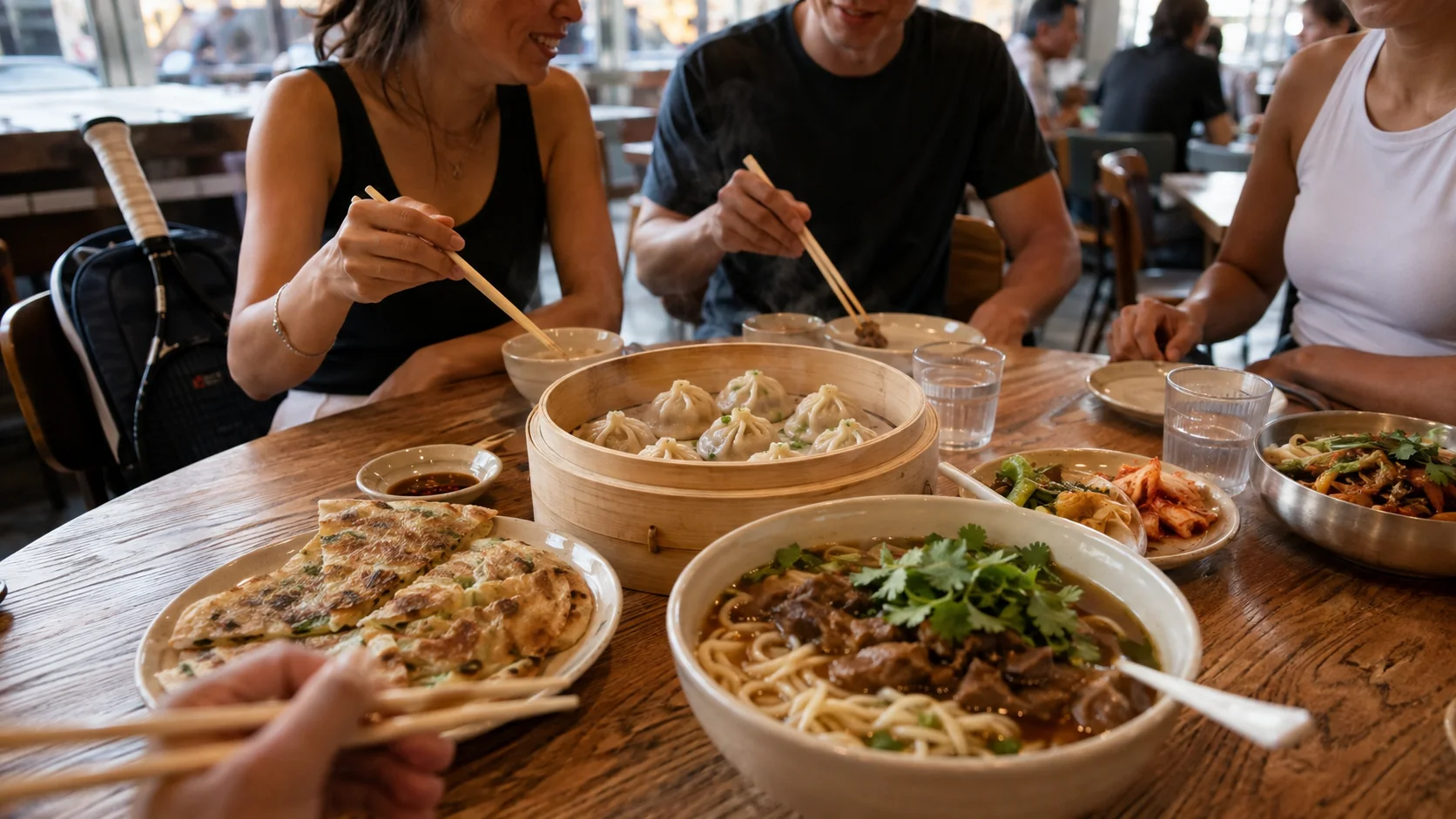
Some visitors assume a full-service dining room is the serious option and a food court is the backup. In Flushing, that hierarchy is not useful. Food courts can offer range, speed, smaller portions, and a way for a group to choose different cuisines without negotiating one menu.
They can also be confusing at peak times. Ordering systems vary. Seating may be competitive. Vendors may accept different forms of payment. Look at what customers are doing before blocking the counter with questions that a posted sign answers.
If you are unsure about spice, ingredients, or allergens, ask directly and understand that cross-contact information may be limited in a busy shared setting.
Skip the “authentic” performance
People use authentic to mean several different things: familiar to a memory, faithful to a regional style, made for a community, not adjusted for outsiders, or simply unlike what they eat elsewhere. The word can sound like praise while placing a restaurant on trial.
A more useful description names the cuisine, the dish, the technique, and what the restaurant says about itself. It does not ask workers to prove cultural legitimacy to a visitor with a phone.
Also retire “hidden gem.” If a restaurant is busy with local customers, it is not hidden. You were late.
Bring a group only if the group can make decisions
Flushing can be excellent for sharing, which attracts groups. Large groups also move slowly, debate menus, and arrive in fragments. Choose a meeting point outside the busiest doorway. Make sure everyone understands the budget and basic cuisine choice before joining a line.
Do not hold a table for three friends who are still at the tennis center. Do not ask a small restaurant to redesign its seating because the group count changed. If the business cannot accommodate you, accept the answer and use the neighborhood’s range to find another option.
The practical plan
For a day session, consider eating in Flushing first, then taking the 7 one stop west to Mets Willets Point with enough time for entry. For an evening session, an early meal can work better than hoping for a late table afterward.
If you are determined to eat after the match, save two current possibilities rather than one. Check hours on the day. Keep the group small. Know your route home. Wear shoes that survived both stadium stairs and neighborhood walking.
The US Open gives you a reason to be nearby. Flushing gives you a reason not to hurry away. Treat those as two different attractions sharing one day, and both will be better for it.
Rising Signal
Worth knowing about as it develops.
PRIMARY SOURCEMTA trip planning ↗
See something that needs attention? Send a correction. We review factual notes and attach meaningful updates to the article.