A regular night at the movies usually begins with a title. You choose what to see, buy a ticket, watch, and leave with a private verdict. Good, bad, too long, worth it, not worth it.
The New York Film Festival complicates that clean sequence. The selection carries curatorial weight. Filmmakers and critics may be present. The audience arrives with advance attention. The lobby becomes a place where opinions form before people are ready to defend them.
NYFF64 runs September 25 through October 12, 2026. The festival began in 1963 and remains noncompetitive, built around selection rather than awards. That history gives the event confidence, but history alone does not explain why the experience feels different from a standard screening.
The difference is the frame around the film.
Curation creates a temporary canon
Every festival selection says this work deserves time. A Main Slate gives a group of films proximity and asks audiences to consider them as part of one season’s serious cinema.
That does not make every selection a masterpiece. It creates an argument. Viewers can question why one film is included, why another section holds a different kind of work, and what the program suggests about contemporary filmmaking.
Commercial theaters also curate through booking, but the logic is usually less visible and more tied to distribution. A festival puts selection itself on display.
Anticipation changes attention
Festival audiences often know they are seeing something before wide release, perhaps before reviews have settled. Scarcity sharpens focus. People arrive early. They read program notes. They watch credits for familiar names.
This attention can improve the experience, but it can also inflate it. A hard-to-get ticket may make an ordinary film feel important. A respected filmmaker’s reputation can silence immediate criticism.
The useful response is not cynicism. It is awareness that the room brings expectations into the movie.
Lincoln Center gives cinema civic scale
Film at Lincoln Center places the festival within an arts campus associated with opera, dance, theater, music, and public gathering. Walking through the plaza toward a screening gives the evening ceremony without requiring a red carpet.
The setting affects behavior. People linger. Several festival conversations can overlap in the same public space. A filmmaker may be entering while another audience is leaving.
The event feels connected to the city’s cultural institutions, for better and for worse. Prestige can create seriousness. It can also make newcomers wonder whether they belong. They do.
The audience is prepared to work
Festival viewers often accept films that move slowly, resist explanation, or use unfamiliar forms. That willingness changes what can happen in the room.
Prepared does not mean superior. An audience can become impatient, overconfident, or eager to display knowledge. Still, shared willingness to meet a film on its terms creates possibilities that ordinary release schedules may not support.
The strongest screenings feel concentrated without feeling like an exam.
Filmmaker presence alters the ending
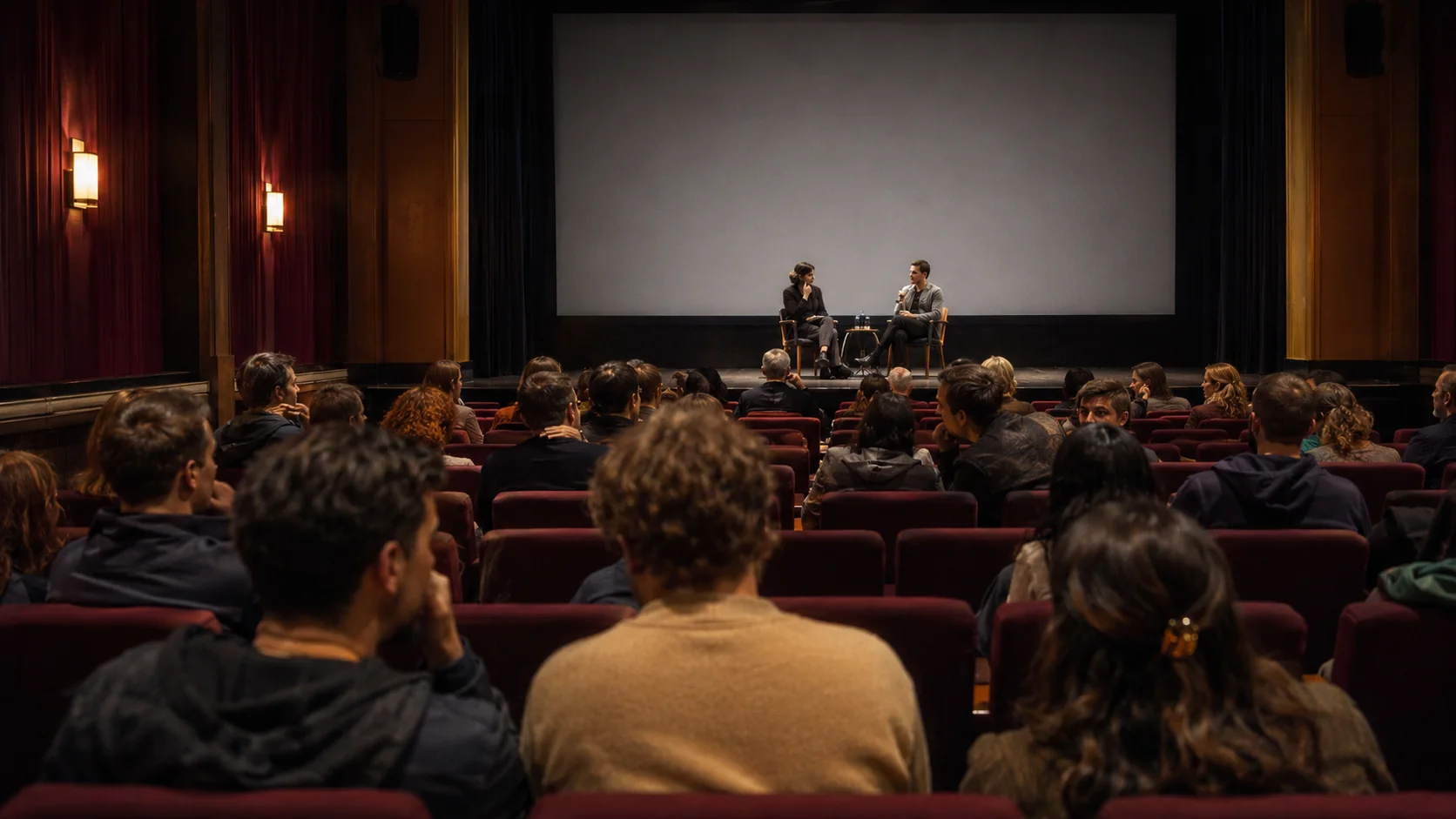
A question-and-answer session turns the filmmaker into part of the public experience. Hearing about casting, editing, research, performance, or production constraints can open the work.
It can also close interpretations too quickly if viewers treat the director’s explanation as the only valid meaning. Films continue beyond intention. Audiences bring histories the creator cannot control.
Listen to the conversation, then keep your own reading alive.
The lobby is where certainty gets tested
People leave a screening with different needs. One wants to talk immediately. Another needs silence. A third begins searching reviews to compare reactions.
The lobby creates accidental encounters between those habits. Someone praises the scene another person thought failed. A detail overlooked by one viewer becomes central to another.
This is not always graceful. Film discussion can become competitive. The person with the fastest reference or strongest opinion takes the room. A better conversation makes space for uncertainty.
The walk to the train matters
Some films become clearer at a distance. An image returns while crossing Broadway. A line changes meaning on the platform. Frustration softens into curiosity, or admiration reveals itself as atmosphere without substance.
The festival’s dense schedule can interrupt that process. Viewers rush into the next screening before the previous film has finished developing in memory.
Leave space between films when possible. Cinema does not end when the house lights rise.
Failure can be productive
A festival film may be ambitious and unsuccessful. It may make a formal choice that creates distance, handle a subject without enough depth, or simply fail to hold attention.
That experience can still be more interesting than competent work with no risk. The point is not to reward difficulty automatically. It is to criticize the actual attempt.
The best festival culture allows a film to fail without turning the evening into wasted time.
History sits in the room
NYFF’s long archive includes filmmakers and films that shaped cinema. Every new edition inherits that reputation.
The history can help audiences see connections across decades, especially through revivals and retrospectives. It can also create pressure to declare the current year significant before time has made that judgment.
Let the 2026 festival be specific rather than historic on arrival. Importance does not need to be announced early.
Newcomers do not need permission
You do not need a film degree, industry job, or complete knowledge of a director’s work to attend. Read the description. Choose something that genuinely interests you. Arrive on time. Stay curious.
If a discussion uses language you do not know, write it down and look it up later. If you dislike a celebrated film, examine why without assuming the room has tricked you.
Festival culture improves when audiences include people who are not already part of the same conversation.
The movie is only half the night
This is not mathematically true. The film remains the reason everyone gathers. Without strong work, the social machinery becomes self-congratulation.
But NYFF feels different because viewing becomes public. Selection, place, audience, history, and conversation change the event. A screening can carry into dinner, the train, and the next day.
That afterlife is the other half. It is why one festival ticket can feel larger than a regular night at the movies, even when the popcorn is the same.
PRIMARY SOURCENYFF history and 2026 dates ↗
See something that needs attention? Send a correction. We review factual notes and attach meaningful updates to the article.