A street sign usually tells you what to do. Stop here, move there, keep this bit of pavement clear. That familiar authority is part of what makes the announced Bronx presentation of Public Address worth following.
The project, conceived by artist Alex Strada, uses signs produced by the city’s Department of Transportation to share perspectives from people living and working in shelters. The Bronx Museum says a central installation will begin at Joyce Kilmer Park on September 14, 2026, with smaller signs distributed across the borough’s community board districts.
This is a preview based on the museum’s published project information ↗. Borough Signal has not seen the Bronx installation. The point of putting it on the radar now is to identify what is planned and give readers a way to approach it without pretending the visit has already happened.
Whose words get to occupy a public place?
Much of the writing that reaches us in shared space comes with an institution behind it. A notice has permission to be there. An advertisement has paid to be there. A person’s account of their own life does not always receive that same automatic room.
Putting lived perspectives on civic signs changes the expected relationship between the object and the reader. That is an interpretation of the project’s premise, not a claim about how every passerby will respond. Some people may stop. Others may keep moving. Public art cannot demand the focused attention a ticketed room might expect.
It can, however, meet people in the middle of an ordinary route. You do not have to begin the day by deciding you are an art audience. There is value in that lower threshold, especially for a work concerned with who is heard in the city.
The subject calls for more care than a quick photograph followed by an uplifting caption. People with experience of shelters are not illustrations of an abstract urban problem. Their words should be read as particular contributions, with the context the project provides. A reader does not need to invent a biography around an unfamiliar name.
If you share an image of a sign, keep its meaning intact. Cropping a phrase into something more convenient for your own post is a poor trade for a few extra likes. Read the accompanying information first. Let the work determine what there is to say about it.
The museum and the park are on separate schedules
There is an important practical distinction here. The museum has announced a temporary exhibition-installation closure from September 7 through October 8. The outdoor project starts during that period. A trip to the park should not be planned on the assumption that the museum galleries will also be open.
Museum components are scheduled to begin October 9. The museum’s pages give differing evening times for that day’s opening, so this preview does not present one as settled. Use the current event notice before making an evening plan. It is better to acknowledge a discrepancy than send someone across the city with false precision.
For the outdoor portion, use the project map linked by the museum, check park access and allow for weather. An outdoor installation is a different kind of visit from a gallery appointment. You can give a small part of it sustained attention without trying to collect every location in one afternoon.
Read before rushing on
There is no need to turn the project into a borough-wide scavenger hunt. The interest lies in what is being communicated and the decision to put it in public view. A single sign, read carefully, may give you more to think about than a hurried set of photographs.
The Bronx deserves cultural coverage that notices both its institutions and the work happening beyond their walls. This is one way those spaces meet. September’s first useful instruction is simple: check which part is open, then give the words some time.
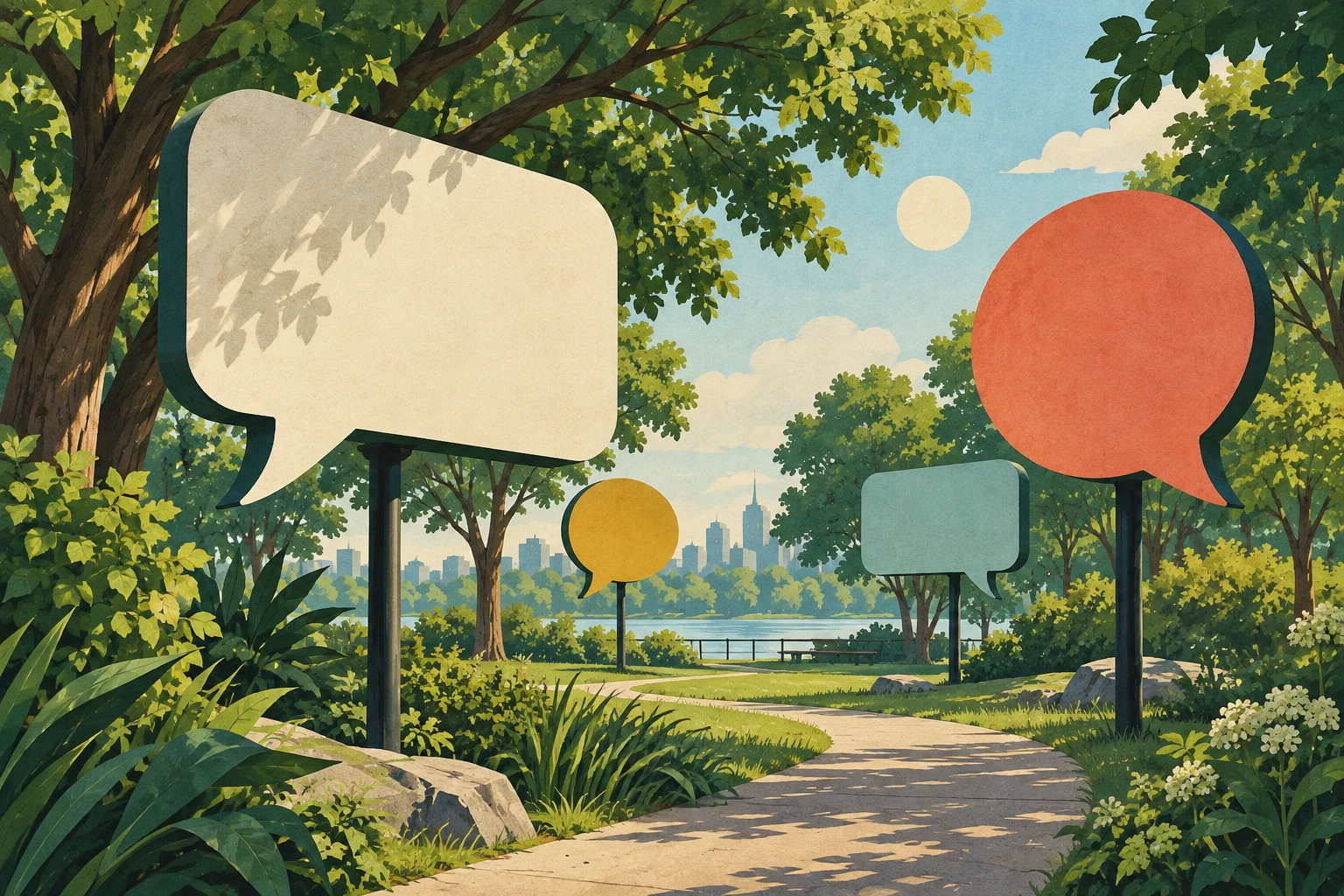
Research checked September 12, 2026. Museum closure notice ↗. Original concept illustration by Borough Signal, not a reproduction or documentary image of Public Address.
PRIMARY SOURCEThe Bronx Museum: Public Address dates and project map ↗
See something that needs attention? Send a correction. We review factual notes and attach meaningful updates to the article.