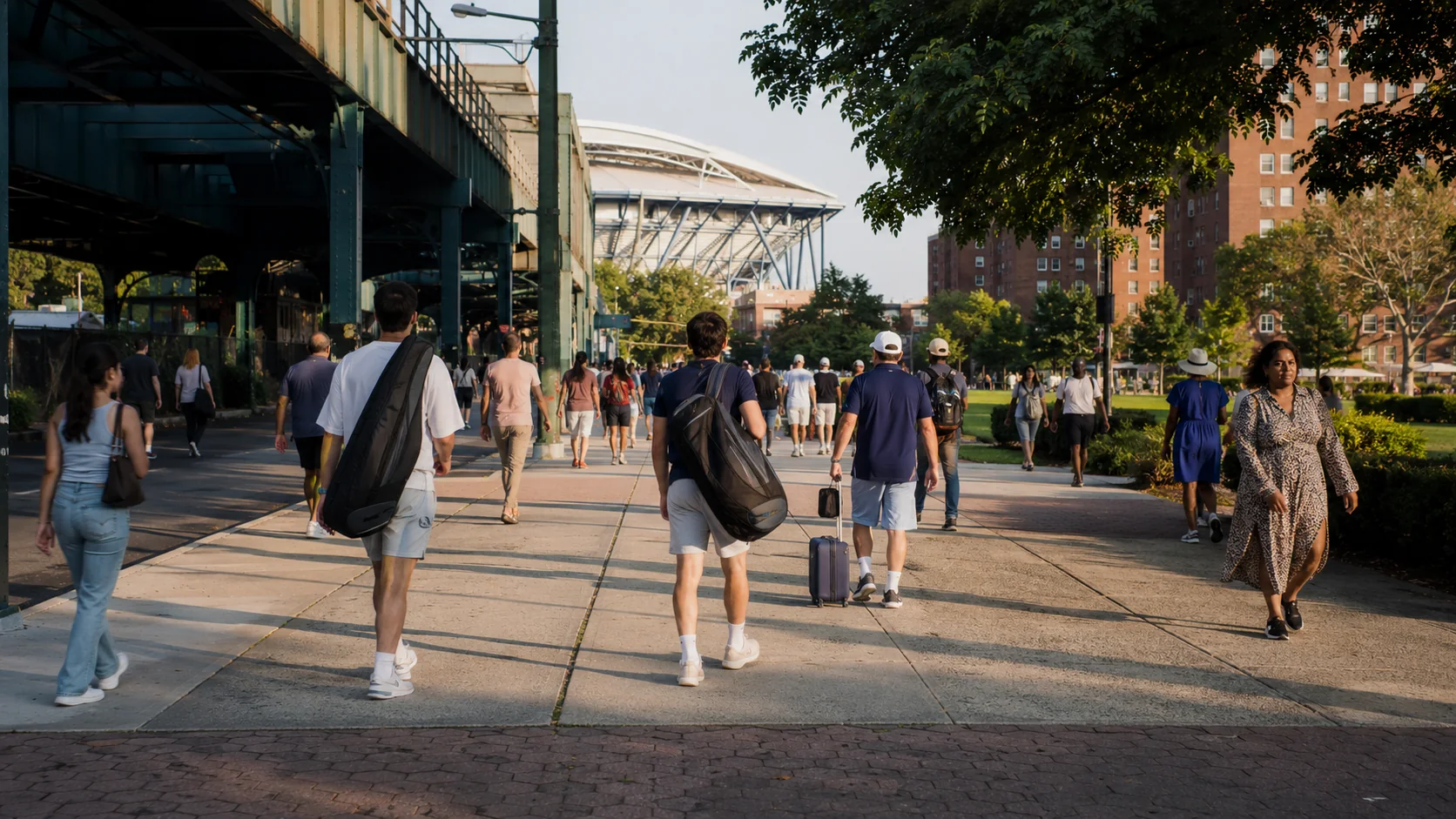
The first sign of the US Open is not a serve. It is a suitcase on the 7 train that is just a little too large for an ordinary Tuesday. Then come the tennis bags, the volunteers in matching shirts, and the visitors studying the subway map as if one wrong stop might send them to another state. By the time the tournament begins, Queens has already been adjusting for days.
The 2026 US Open runs from August 23 through September 13 at the USTA Billie Jean King National Tennis Center. Fan Week occupies the first stretch, from August 23 through August 29, before the main draw takes over. Those dates matter, but they do not explain the whole event. A tournament this large changes the movement around Flushing Meadows Corona Park, the platform at Mets Willets Point, and the decisions people make about where to eat before going home.
This is a Signal Desk story, researched before the tournament. It does not pretend that Borough Signal has walked the grounds this year or tasted its way through Flushing on behalf of readers. What it can do is explain the geography, the timing, and the part of the US Open experience that is easy to miss when every camera points toward the court.
The tournament has a borough outside it
The tennis center sits inside one of the most layered pieces of public land in New York. Flushing Meadows Corona Park carries the remains of two world’s fairs, major sports venues, museums, recreation fields, lakes, highways, and the daily routines of nearby communities. Visitors often travel through that complexity quickly. They leave the train, follow the crowd, cross the boardwalk, and enter the grounds.
Queens does not become a tennis campus just because a major tournament arrives. It stays Queens. Families are still moving between errands. Local workers are still commuting. Park users are still trying to reach soccer fields and playgrounds. The event adds another current to a place that already has several running through it.
That is why the approach matters. If you arrive believing the US Open exists in isolation, the trip can feel like an airport transfer. If you pay attention to the neighborhood around it, the tournament begins to look less like a sealed spectacle and more like a temporary force inside a living borough.
The 7 train becomes part of the story
There are faster ways to describe the trip than to romanticize the subway. The 7 can be crowded, hot, delayed, and full of people who have different ideas about how much doorway space a tennis bag deserves. Still, it offers a useful view of the event building in real time.
As the train moves east, office towers give way to rooftops, elevated tracks, busy commercial streets, and long views across Queens. Riders headed to the tournament begin recognizing one another without speaking. The shared destination becomes obvious. At Mets Willets Point, the train releases a crowd that suddenly moves with surprising agreement.
Allow more time than the schedule says you need. The official gate time is not the same as the time it takes to leave the train, follow security instructions, and find a seat. Evening sessions can produce their own complications when a large crowd leaves at once. The smartest transportation plan is not clever. It is simply generous.
Flushing is not the concession stand
The temptation is to turn downtown Flushing into an extra feature of the tournament, a place to collect a meal before or after tennis. That framing is too small. Flushing is one of New York’s most active commercial and food districts, with its own reasons for being crowded and its own pace. It does not need the US Open to make it relevant.
Visitors should approach restaurant research with some humility. Menus change. Businesses close, move, or adjust hours. A recommendation copied from an old list can create a wasted trip. Check current restaurant websites or direct listings, choose a manageable area, and avoid building a schedule that requires three rushed meals between matches.
It is also worth remembering that a neighborhood is not a tasting challenge. Buying one good lunch, walking a few blocks, and returning another day is a better relationship with the place than treating every counter as content.
Fan Week changes who gets through the gate
Fan Week is scheduled for August 23 through August 29. The grounds are free to enter during that period, but adults are required to have a free Fan Access Pass in 2026. That change deserves attention before anyone heads to Queens assuming that free means no planning.
Qualifying matches are one of the strongest reasons to go. The atmosphere is different from the main draw. Players are fighting for a place in the tournament, practice courts can reward patient spectators, and the grounds allow more wandering. It is tennis without the same ticket price, though it is not an empty secret. Crowds know about Fan Week now.
Families and first-time visitors may find this the most flexible way to understand the site. There is less pressure to justify an expensive seat by remaining in it all day. You can learn the distances, see how the courts connect, and decide what kind of future visit would actually suit you.
What the cameras usually miss
Major sporting events encourage a narrow kind of attention. We see the famous player, the packed stadium, the celebrity in the stands, and the plate of expensive food held close to a phone. The ordinary labor around the event receives less space.
Transit workers manage waves of riders. Security teams answer the same question hundreds of times. Cleaning crews reset spaces between crowds. Restaurants and stores nearby face unpredictable rushes. Residents adjust routes they would normally take without thought. The tournament is also made from those small accommodations.
None of this requires pretending that the event is a burden or a miracle. It is simply large. Large events leave a footprint, even when the footprint is temporary and welcome.
A better way to plan the day
Choose one priority. It might be a particular match, an afternoon on the outer courts, or enough time in Flushing for dinner after the session. Build the rest of the day around that priority instead of trying to win at scheduling.
Check the official US Open schedule before leaving. Confirm the Fan Access Pass requirement if you are attending Fan Week. Review MTA service information, especially on weekends. Wear shoes that make sense for long walks. Bring only what current venue rules allow. If you plan to eat outside the grounds, verify hours that same day.
Most important, leave a little space between tennis and the train home. Queens will still be moving after the final point. The most memorable detail may arrive once the match is over and the crowd has to become part of the city again.
Strong Signal
Worth making the trip.
PRIMARY SOURCEOfficial US Open schedule ↗
See something that needs attention? Send a correction. We review factual notes and attach meaningful updates to the article.