A subway map reduces Roosevelt Avenue at 74th Street to a useful knot. The 7 train crosses above. The E, F, M, and R connect below through the Jackson Heights Roosevelt Avenue and 74th Street Broadway station complex. Colored lines meet, and the map tells riders where to change.
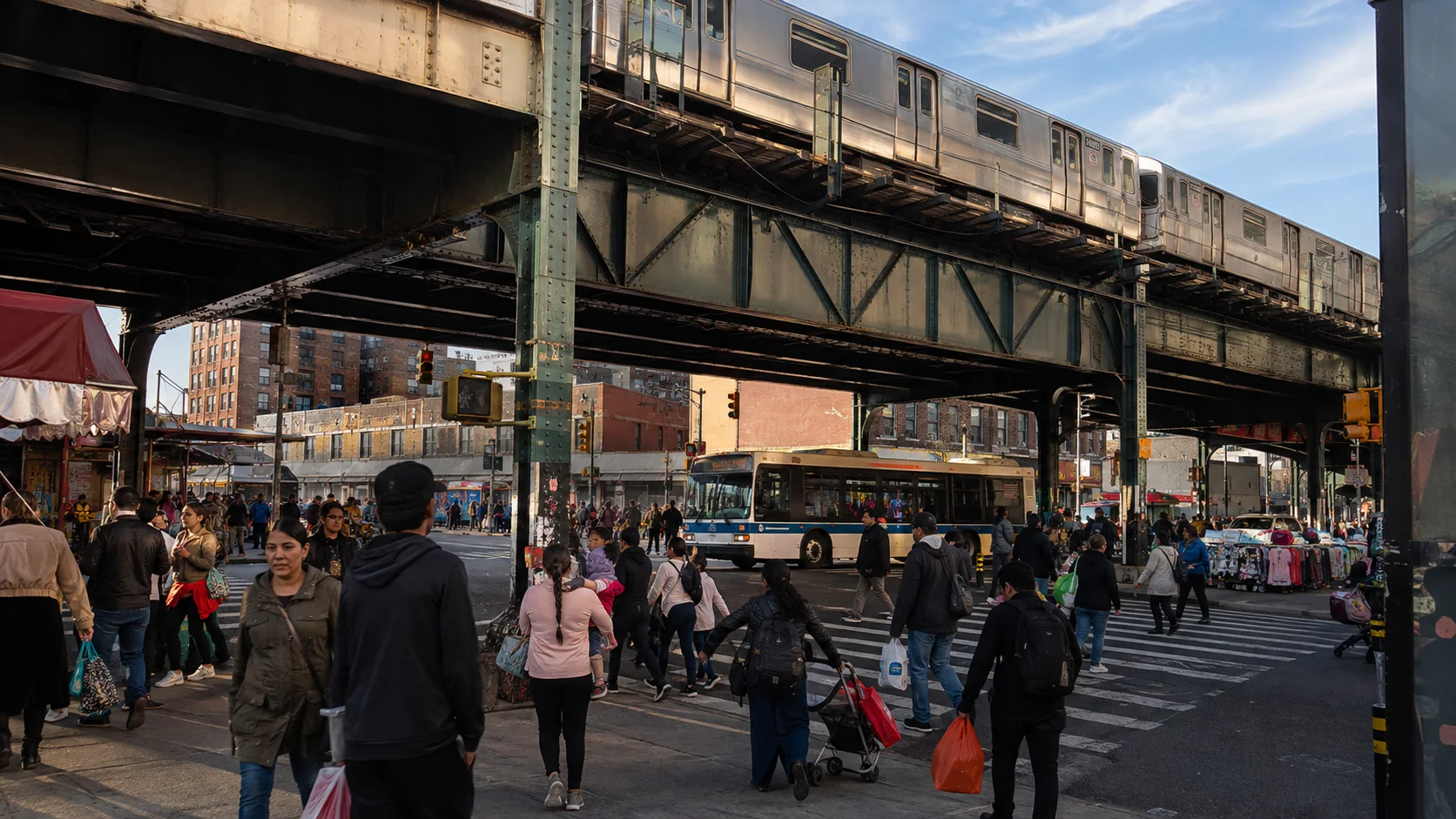
At street level, the transfer becomes a place. Buses pull in. Vendors watch the flow. People emerge from different exits with different errands. Storefront signs carry several languages. The elevated tracks divide light and sound. A person who knows the corner reads it quickly. A person arriving for the first time may need a minute to understand which direction is which.
This first One Block feature is marked Signal Desk. It uses public information and city context. Borough Signal has not completed the reporting visit, photography, or street interviews required for a Field Signal label. That limitation is not a footnote. A block deserves more than imagined observation.
The station is not background
Transit determines the rhythm here. The station complex is one of the busiest transfer points in Queens because it connects local and express subway service with buses and the surrounding commercial district. A delay below can produce a crowd above. An arriving bus can change the sidewalk in seconds.
The elevated 7 train gives Roosevelt Avenue a physical ceiling. Steel columns interrupt the curb. Train noise arrives in intervals, briefly overtaking conversation. Under the structure, light changes by hour and season. Businesses operate inside that repeated interruption.
City stories often treat transportation as a direction at the end: take these trains, use this exit. On this block, transportation is one of the main characters.
Every exit tells a slightly different story
Large station complexes teach riders that an exit is a decision. Choose one stairway and you meet a bus stop. Choose another and you face a row of shops. The difference may be less than a block, but crowded intersections make small distances feel larger.
People familiar with the station carry an internal map built from landmarks that may never appear on an official sign. A bakery, pharmacy, bank, awning, cart, or particular corner becomes the instruction. Turn where the sidewalk widens. Cross after the bus passes. Stay on the side with the store you recognize.
This practical knowledge is part of neighborhood expertise. It is also fragile. When a business closes, one piece of the private map disappears.
Commerce is measured in small frontage
Jackson Heights and nearby Elmhurst contain an extraordinary concentration of small businesses. On and around Roosevelt Avenue, narrow storefronts carry a large amount of economic and social life. A shop may serve customers in more than one language, provide specialized products, handle remittances, sell food, or offer services tied to immigration and daily household needs.
From outside, a visitor may see visual abundance. For an owner, the same block means rent, deliveries, permits, staffing, weather, competition, and the unpredictable effects of construction or enforcement.
Coverage should not use storefront variety as a colorful texture while ignoring those pressures. A commercial corridor is beautiful partly because people keep doing difficult work inside it.
Food is present, but this is not a crawl
The area is famous for food from across South Asia, Latin America, the Himalayas, and other parts of the world. That reputation attracts visitors who arrive with lists. Lists can be useful, but they can also produce a strange kind of haste. People photograph one dish, cross a business off, and rush to the next place.
A One Block story should move more slowly. What does the restaurant serve at breakfast that differs from dinner? Who uses the counter on an ordinary weekday? How long has the business been in the same location? Which item is popular online, and which one matters to regular customers?
Those questions require reporting. Until Borough Signal can ask them directly, restaurant references remain context rather than reviews.
Language is infrastructure
Multilingual signs do more than announce cultural diversity. They help people complete tasks. A sign tells a customer that a service is available in a language they understand. A menu carries names that preserve regional distinctions. A flyer connects people to work, housing, lessons, legal help, worship, or a community event.
Translation also happens person to person. A family member explains a form. A worker switches languages between customers. A stranger points someone toward the right platform.
This labor is easy to overlook because it is woven into ordinary exchange. On a block like this, language keeps the city functional.
Public space is negotiated, not empty
Sidewalks around a major station must do several jobs. They move commuters, hold bus queues, provide space for vendors, receive deliveries, allow people to stop, and create the edge of every business. Conflicts are inevitable because the space is limited.
The usual public-space question asks whether a sidewalk is crowded. A better question asks crowded with what, for whom, and at what time. A queue that feels like an obstacle to one person may be the entrance to another person’s livelihood. Clear access for wheelchairs and strollers remains essential. So does understanding how rules affect small vendors.
The block is constantly solving and failing to solve these competing needs.
What changes first
Neighborhood change rarely announces itself with one dramatic event. A lease ends. A familiar sign comes down. A chain opens nearby. A station entrance closes for work. A new building changes the wind and shadow. Enforcement patterns shift. A business adapts its menu to a new audience.
Roosevelt Avenue is watched closely in arguments about safety, regulation, development, and immigration. Those debates can turn real people into symbols. Reporting must resist that flattening. A block is not evidence for a position before it is a place where people live and work.
Future One Block reporting should include business owners, workers, residents, commuters, vendors, and people responsible for public services. No single interview can speak for the corner.
How to visit without consuming the block
If you are coming for food or exploration, choose one or two places rather than a competitive itinerary. Keep station entrances clear. Ask before photographing identifiable people. Do not treat multilingual signage as a novelty. Buy something if you spend time inside a small business. Check current hours directly.
Use the visit to learn the geography, not to declare mastery. Roosevelt Avenue at 74th Street changes between morning and midnight, weekday and weekend, rain and heat. One afternoon provides only one angle.
That is the reason Borough Signal created One Block. A small area can reveal transit, labor, migration, commerce, public policy, memory, and appetite at once. The map shows a transfer. The block shows what is being transferred: people, money, language, knowledge, and the daily work of making New York run.
See something that needs attention? Send a correction. We review factual notes and attach meaningful updates to the article.