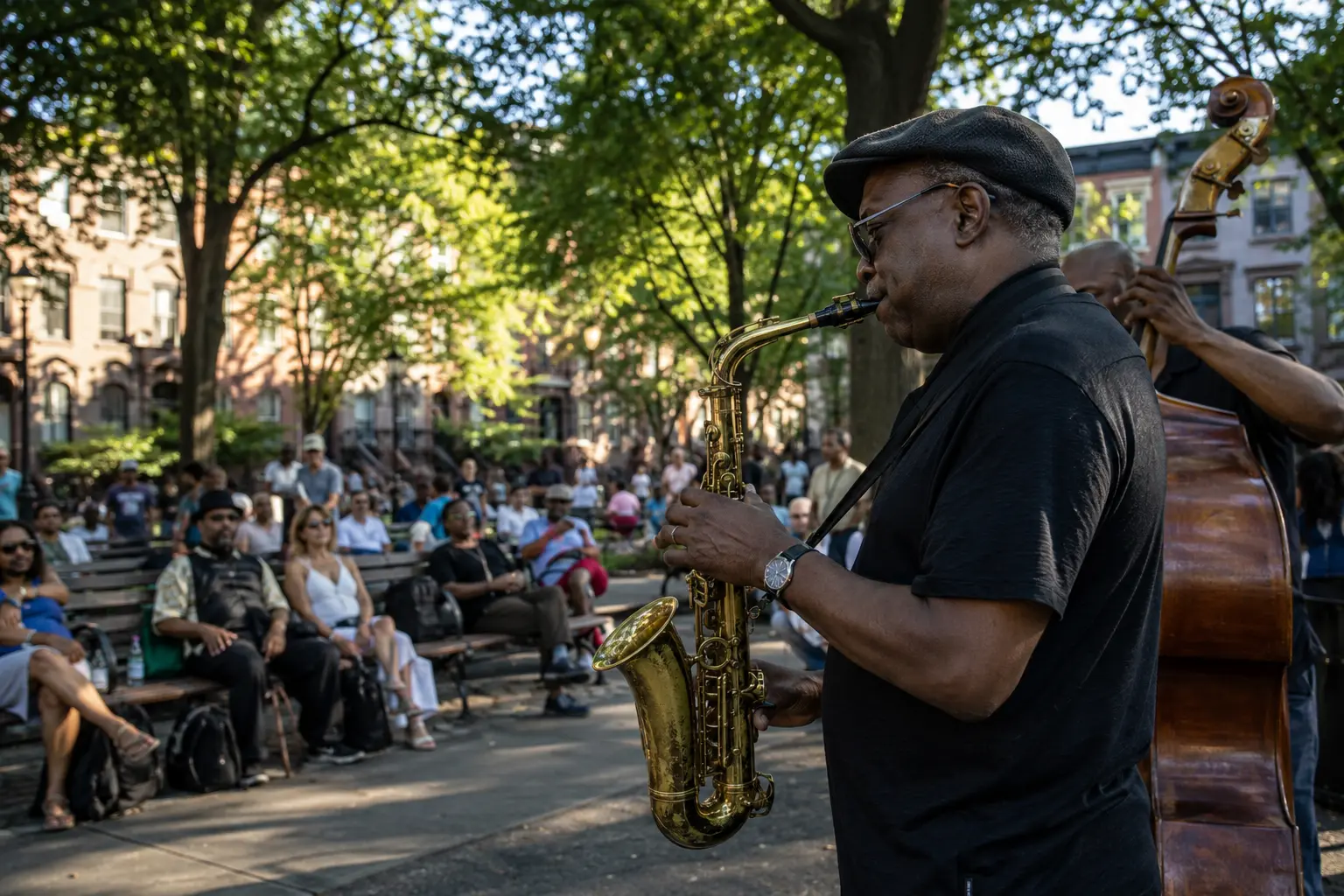
There is a particular New York pleasure in hearing music before you see where it is coming from. A saxophone gets through the trees. Somebody slows down without deciding to. A child starts moving to a rhythm their grown-up was not planning to stop for. Suddenly a regular walk through a public park has a different shape.
That is the promise of the Charlie Parker Jazz Festival, returning August 28 through August 30, 2026. City Parks Foundation’s festival brings major musicians, newer voices, longtime listeners, and accidental listeners together around free public programming in Harlem and the East Village.
You do not need a special relationship with jazz to belong there. You do not need an expensive ticket, a favorite Blue Note recording, or an opinion about chord changes. You need enough curiosity to stay for a song.
Three days, three different invitations
The festival begins Friday, August 28, from 7 p.m. to 9:30 p.m., with the Jazz at Lincoln Center Orchestra, special guests Marquis Hill and Ekep Nkwelle, music director Sherman Irby, and the Bill Saxton Harlem All-Stars. City Parks Foundation lists the opening program as free.
If your ideal introduction to jazz includes a big ensemble, a sense of occasion, and a crowd settling in as evening arrives, Friday is an excellent place to begin. An orchestra gives you room to hear the music as conversation: one instrument stepping forward, another answering, a whole group changing direction without anybody needing to explain what just happened.
Saturday, August 29, runs from 2 p.m. to 7 p.m. The listed lineup includes Joshua Redman, Nat Adderley Jr., Catherine Russell, Nicole Glover, and DJ Kultured Child. That combination crosses generations and approaches without treating the audience like it has to choose one correct version of jazz.
Sunday, August 30, runs from 3 p.m. to 7 p.m., with Ravi Coltrane, the Billy Hart Quartet, Kassa Overall, and Vanisha Gould. If you want a day that makes the connection between jazz history and the music’s ongoing evolution especially clear, Sunday offers a strong argument.
Check the official Charlie Parker Jazz Festival calendar ↗ before you travel. Outdoor performances can change, and additional related events appear around the main weekend.
Why these parks make sense
Charlie Parker’s place in New York is not a vague tribute pasted onto an outdoor concert. Harlem and the East Village carry different parts of the city’s musical memory, and the festival’s recurring relationship with Marcus Garvey Park and Tompkins Square Park gives that history physical surroundings.
Harlem has never needed an outsider to discover its cultural importance. The neighborhood’s relationship to Black music, nightlife, performance, and creative community is part of how New York became New York. Bringing a public audience into that setting asks visitors to recognize the neighborhood as a living place, not a backdrop borrowed for a tasteful weekend photograph.
The East Village holds another thread of Parker’s New York story. Tompkins Square Park and its surrounding blocks carry a different neighborhood rhythm, one shaped by overlapping communities, artistic traditions, public arguments, and the city’s ongoing habit of becoming something new before anybody finishes describing the old version.
The festival connects those locations without requiring visitors to treat culture as a scavenger hunt. You can arrive, listen, and let the setting do some of the work.
Charlie Parker without the homework assignment
Charlie Parker helped transform jazz through a style of improvisation that moved quickly, took unexpected turns, and changed how musicians approached melody and rhythm. That is enough history to get you started.
You do not need a graduate seminar before hearing why that matters. Think about any art form becoming more adventurous because someone refused to keep repeating the same safe pattern. Parker pushed the music into new possibilities, and the consequences are still audible in musicians who may sound completely different from him.
The point of a festival in his name is not to preserve jazz behind glass. It is to show how a musical tradition keeps changing because people are still willing to argue with it, stretch it, and bring their own lives into it.
That is why placing established players beside newer voices works. The history remains visible, but the festival does not ask anybody to behave as if the best thing jazz ever did already happened.
A guide for people who think they do not know jazz
Start by ignoring the fear that everyone else understands something you do not. Most people at an outdoor concert are listening for the same basic reasons: a sound caught their attention, the performance feels alive, or being outside with other people turned out to be better than another hour of scrolling.
Listen to the drums for a while. Then follow the bass. Notice when a horn steps forward and how the rest of the band reacts. If somebody starts singing, you already know how to listen to a voice.
You are allowed to enjoy one set and leave. You are allowed to stay because the next musician sounds different. You are even allowed to decide a particular performance is not for you without declaring that jazz, as an entire century-spanning art form, has been officially reviewed and rejected.
Free programming makes this kind of experimentation possible. Nobody has to justify a high ticket price by pretending every minute changed their life.
What to bring, and what not to do
Bring water, comfortable shoes, appropriate sun protection, and a lightweight layer if the evening turns cooler. Check the organizer’s guidance for seating, bags, accessibility, and any weather-related updates.
If you bring a blanket or chair, be thoughtful about the people behind you. Keep walkways open. Avoid building a private compound around your group with bags, coolers, and enough supplies to establish diplomatic relations.
Eat locally if you can, but remember that neighborhood restaurants and shops are not props in your festival experience. A purchase, a little patience, and ordinary courtesy go further than announcing you found a hidden gem in a place people already live.
Arrive early if a particular artist is the reason you are going. If you are flexible, arriving between performances may offer an easier rhythm. Either way, check the official schedule again that morning.
The part worth keeping
New York is good at making culture feel expensive before it even begins. There is a fee, a ticket tier, a dress code that technically is not a dress code, and a recommendation to upgrade your experience for another forty dollars.
The Charlie Parker Jazz Festival suggests a different model. A major artist can appear in a public park. A stranger can hear a piece of music they did not know they needed. A longtime fan can stand near a family encountering the sound for the first time.
For more New York culture reporting, Manhattan neighborhood stories, and free events worth noticing, start with what is actually happening around you.
The best free jazz in NYC next weekend does not require you to become an expert. It asks you to show up, listen for a while, and remember that a city sounds different when its best rooms do not have walls.
City Signal
Something especially memorable or important to the city.
PRIMARY SOURCEOfficial Charlie Parker Jazz Festival schedule ↗
See something that needs attention? Send a correction. We review factual notes and attach meaningful updates to the article.