A museum wall tells you where to stand. A waterfront meadow makes no such demand.
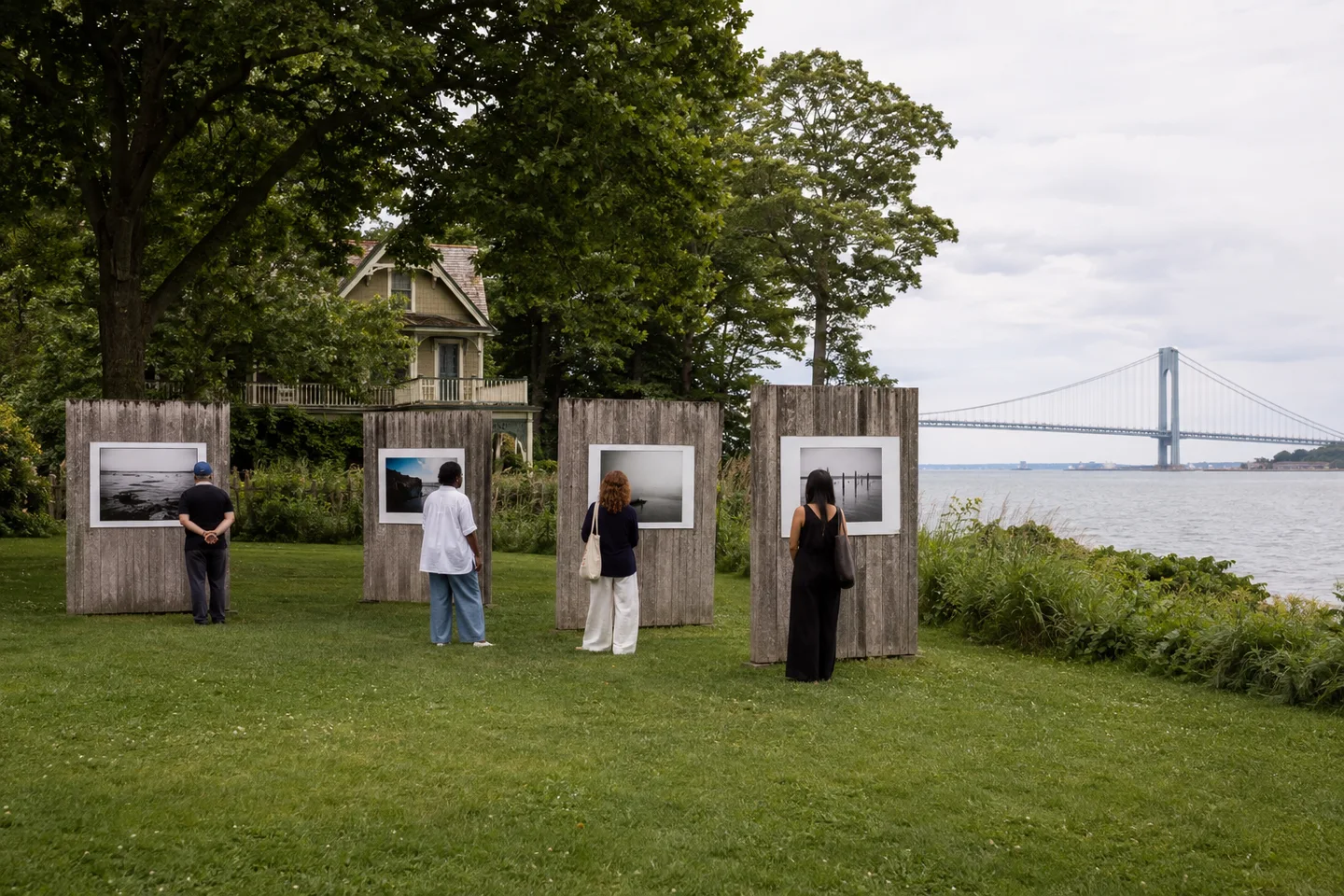
At Alice Austen House, documentary photographs appear outside, where grass, weather, harbor traffic, and the occasional distracted passerby become part of the viewing experience. The institution’s 2026 Photoville presentation extends beyond its Rosebank grounds to the South Beach boardwalk, turning two pieces of Staten Island shoreline into places to encounter images without first crossing a ticket desk.
The project is free to experience outdoors, according to the Alice Austen House’s official festival announcement ↗. Its published schedule says the installations opened May 16 and continue through summer 2026. Check the museum for the most current display and access information before planning a late-season visit.
A photograph can change when the sky is part of its frame
An outdoor picture is never quite alone. The light moves across its surface. Wind rearranges the surrounding trees. A person walking through the park can stop for five seconds or stay long enough to notice an unfamiliar detail.
Those conditions matter for documentary work, which asks viewers to consider other lives and perspectives without reducing them to scenery. Seen beside the harbor, a picture becomes part of a conversation about movement, community, memory, and who has historically been allowed to document a city.
That does not mean the waterfront illustrates every image or that every artist is telling the same story. It means the setting offers room for the work to breathe. You do not have to whisper, know the appropriate vocabulary, or decide in advance that you are the kind of person who visits photography exhibitions.
Sometimes you are simply a person taking a walk who encounters something worth another look.
Six photographers, one invitation to pay attention
Alice Austen House identifies Niamh Alarcon, Lila Barth, Timothy Briner, Adán Huertas, Paul Moakley, and Emily Schreier as the participating artists. Victoria Munro is named as curator. Those names belong to the people who made and organized the work; an honest guide should acknowledge them rather than flatten the exhibition into an anonymous backdrop for a pretty outing.
The museum describes the program as documentary photography. Individual projects have their own subjects and intentions, so readers should consult the official installation materials rather than assume we interviewed the artists or attended a particular opening.
That distinction matters. A publication can report that a real exhibition exists, identify the people credited by its organizer, and explain why the format is accessible without manufacturing reactions from visitors. Curiosity is a good enough starting point.
For anyone searching for free outdoor photography exhibitions on the Staten Island waterfront, this is the rare answer that combines named creative work with two actual locations. It is not a promise that every piece remains visible forever; outdoor schedules and conditions are always subject to change.
Rosebank has an artistic history that deserves its own introduction
Alice Austen House is located at 2 Hylan Boulevard, Staten Island, NY 10305. The museum preserves the home and legacy of photographer Alice Austen, whose work documented aspects of New York life in the late nineteenth and early twentieth centuries. The setting is not a generic picturesque cottage; it is a cultural institution tied to a specific photographer and a particular stretch of harbor.
The outdoor meadow and the indoor museum should not be treated as identical experiences. Museum admission, opening hours, accessibility, and special-event policies may differ from access to the surrounding grounds. The organization publishes its current visitor information directly, and checking it prevents a free outdoor plan from becoming an avoidable misunderstanding.
Rosebank also deserves better than being described only in relation to Manhattan. The neighborhood has its own homes, local routines, and waterfront relationship. Arrive with that perspective and the visit becomes more than a scavenger hunt for a bridge in the background.
The boardwalk offers a second, completely different pace
The South Beach installation brings the project into another public environment. A boardwalk carries walkers, families, cyclists where permitted, and people who may not have set out to see art at all. That mix changes the relationship between the work and its audience.
Rather than trying to force both locations into one rushed itinerary, consider choosing the setting that works for your mobility, schedule, and transportation. Check current conditions, bring water on hot days, and keep pathways clear for the people already using the space.
If you photograph the installation, respect the artists’ work and the privacy of other visitors. An exhibition placed in public does not turn everybody standing near it into a willing subject.
The best admission price is permission to be curious
New York contains plenty of cultural experiences that ask for advance tickets, careful budgeting, and the correct arrival window. Those institutions can be wonderful. They are not the only way art belongs to the city.
An outdoor photograph on Staten Island offers another model: show up respectfully, read the credit, take the time you have, and leave with a question you did not bring. That is not a smaller version of a gallery visit. It is its own generous kind of encounter.
Find more New York arts and culture coverage, explore verified local events, or browse additional Staten Island stories. The harbor will not tell you what the pictures mean. Fortunately, it does not have to.
Strong Signal
Worth making the trip.
PRIMARY SOURCEAlice Austen House official Photoville 2026 announcement ↗
See something that needs attention? Send a correction. We review factual notes and attach meaningful updates to the article.