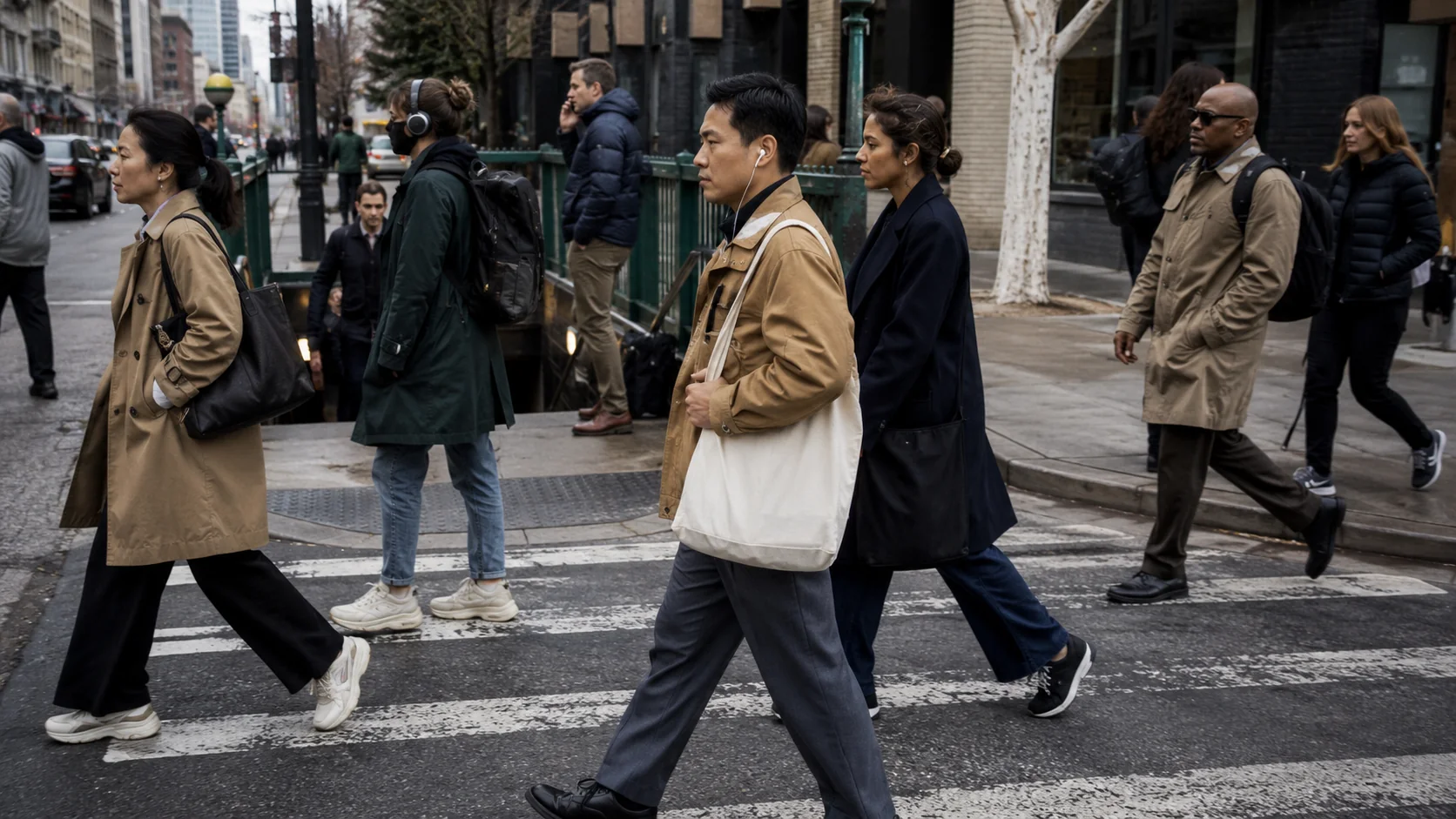
New York street style is often photographed between a black car and a fashion show. The subject is prepared, the outfit has a clear point, and the street functions as evidence that the clothing has entered real life.
Most actual New York dressing happens with less cooperation. The train is delayed. Rain starts sideways. The office is too cold. Dinner is across town. The shoes need to survive stairs, sidewalk grates, and several hours longer than promised.
Street style is the visual result of people solving those problems without giving up identity. Sometimes the solution is elegant. Sometimes it is a tote bag containing three backup solutions.
Shoes reveal the real plan
An outfit can claim anything. Shoes reveal distance.
People who walk and use transit make calculations about heel height, support, weather, and the possibility of standing. Some carry a second pair. Some build the entire look around sneakers or boots. Others accept pain because the shoe is the point.
There is no moral prize for comfort, but practical choices are part of the style story. Pretending otherwise reduces city dressing to a still image.
Layers are a transit system
New York temperatures can change from sidewalk to platform to train car to office within 20 minutes. Layers allow a person to adjust without completely changing the outfit.
A jacket may be carried more than worn. A scarf becomes protection from air conditioning. A light shirt sits under something heavier because the evening will end near the water.
This constant adjustment encourages combinations that look deliberate because they have been tested through necessity.
Workwear means many different jobs
Street-style coverage often focuses on creative offices and fashion industries. New Yorkers also dress for hospitals, schools, kitchens, construction sites, courts, salons, retail floors, delivery routes, and jobs with uniforms.
Personal style appears inside those limits through jewelry, hair, outerwear, bags, nails, color, fit, and what happens after the shift ends.
A city style story should notice workers without treating uniforms as costumes or photographing people without consent.
Neighborhood context matters, but stereotypes fail
Different commercial streets, nightlife areas, campuses, business districts, and cultural communities produce visible patterns. Those patterns are not rules. Brooklyn does not have one outfit. Queens is not a collage of traditional dress. The Bronx is not a single streetwear mood. Manhattan contains more than expensive minimalism. Staten Island is not absent because fashion media rarely makes the trip.
Describe what is actually visible in a specific place and time. Do not assign an entire borough a closet.
Trends arrive unevenly
One silhouette may dominate social platforms while barely appearing on the morning train. Another spreads through resale, uniforms, club culture, sports, or music before fashion media names it.
New York’s density lets trends cross paths. A luxury piece sits beside a thrifted coat. A teenager adapts a runway idea with different materials. An older person wears a shape they never stopped wearing, now declared current again.
The city makes trend ownership difficult, which is healthy.
Bags carry the unphotographed outfit
The perfect small bag becomes less perfect when the day requires a laptop, charger, water, medication, lunch, umbrella, book, and alternate shoes.
Totes, backpacks, shopping bags, and rolling cases are part of New York style because people carry the day with them. The bag may disrupt the line of an outfit while making the outfit possible.
Good street photography does not crop out every practical object to preserve fantasy.
Weather edits everyone
Rain exposes fabric choices. Heat changes color and proportion. Wind tests hats. Snow covers shoes with evidence.
Some of the strongest city style appears when people adapt quickly: socks changed, hems lifted, hair wrapped, jacket tied, umbrella coordinated by accident.
Weather also creates access and health concerns. Extreme heat is not an invitation to judge people for dressing less formally. Style exists inside the body’s need to remain safe.
Grooming is part of the composition
Hair, nails, skin, scent, makeup, facial hair, and protective styles shape how clothing reads. They also involve time, money, technique, and cultural knowledge.
Street-style coverage should credit those choices without demanding personal explanations. A hairstyle can carry history, but a stranger wearing it does not owe a reporter a lesson.
Ask before photographing. Ask again before publishing a name or detailed caption.
Money is present even when labels are hidden
An apparently simple outfit can be extremely expensive. A dramatic one can be assembled from swaps, family closets, discount stores, thrift, alterations, and handmade work.
Price alone does not create taste. Access affects options. So do body size, disability, religious practice, workplace rules, and the limited ranges many brands produce.
Coverage should not frame wealth as effortless elegance while praising everyone else for ingenuity. Both involve choices, but the available choices are not equal.
The camera changes the street
Once someone knows they are being photographed, posture and expression shift. That does not make the image fake. It makes it a collaboration.
The ethical problem is taking identifiable photographs without meaningful permission, especially when the subject is a child, worker, or person in a vulnerable situation. A public sidewalk is not a waiver of human consideration.
Borough Signal will ask. A strong outfit is not more important than privacy.
What we mean by New York street style
We mean clothing in motion, shaped by the day it has to survive. We mean personal decisions made inside weather, work, culture, budget, body, transit, and pleasure. We mean the outfit that looks better because the wearer has somewhere to be.
Fashion-week images are part of that story, but not the whole thing. The city’s style is also visible on an early bus, outside a salon, at school pickup, behind a counter, in a courthouse elevator, and on the last train home.
New York street style is not one look. It is a citywide habit of solving practical problems without surrendering the right to be seen on your own terms. That is the outfit worth noticing.
See something that needs attention? Send a correction. We review factual notes and attach meaningful updates to the article.