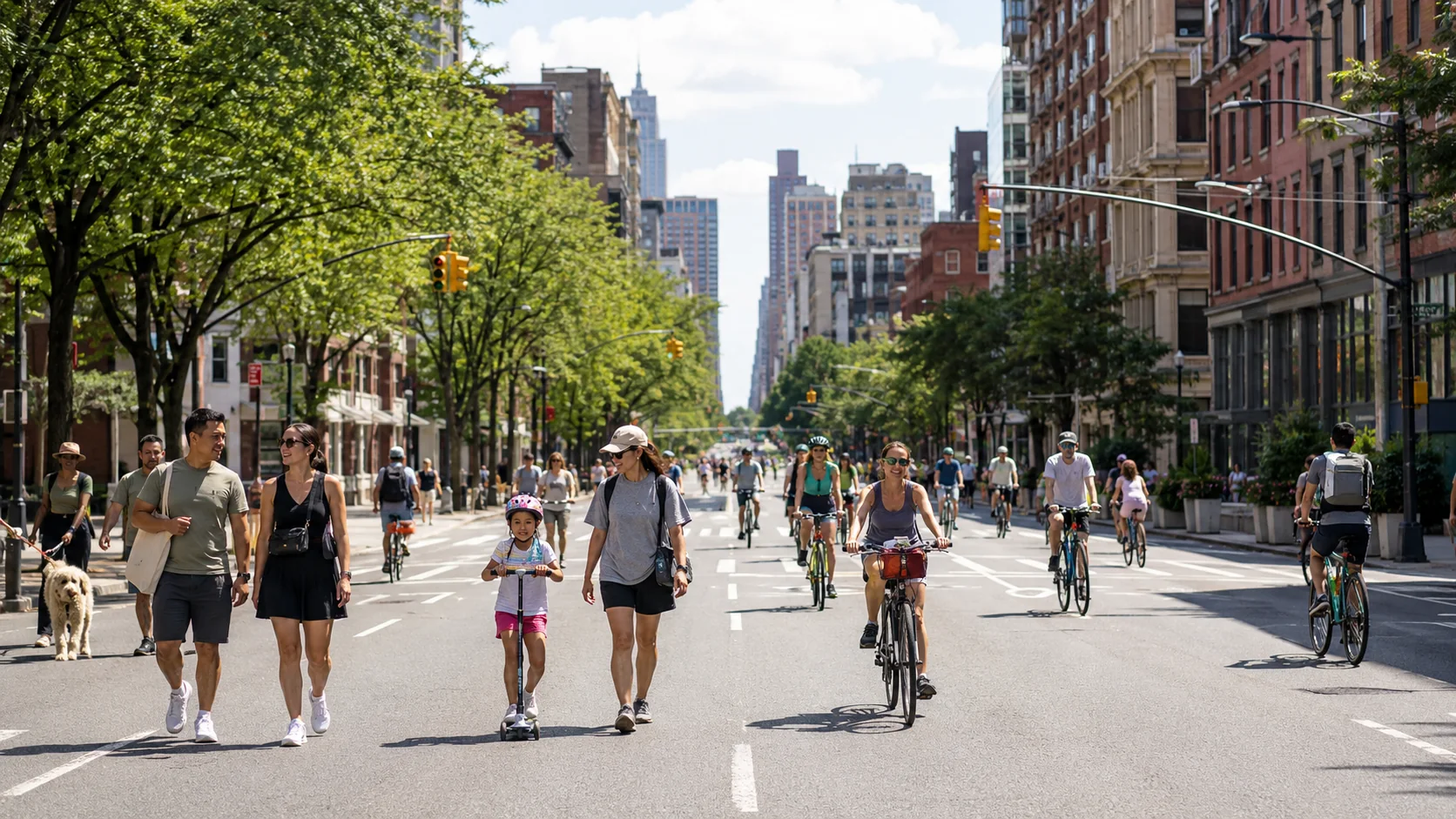
NYC Summer Streets opens more than 20 miles of roads to people across five boroughs. That does not mean you need to travel all 20 miles. It does not mean you need a bicycle, matching athletic clothes, or a watch recording proof that you used the street correctly.
The 2026 program runs on five Saturdays. Queens and Staten Island opened the schedule on July 25. Manhattan dates are August 1, August 8, and August 15. Brooklyn and the Bronx follow on August 22. Official hours and route details vary, so NYC DOT’s current information is the final source.
Summer Streets is simple in theory: remove through car traffic from selected roads and let people walk, run, ride, play, attend programs, and see familiar streets differently. In practice, thousands of people arrive with different speeds and plans. The event works when everyone remembers the street is shared.
Pick a section, not a conquest
The complete route is appealing to cyclists and runners who want distance. Families with children, older adults, visitors with limited mobility, and people interested in programs may have a better day choosing a shorter portion.
Look at rest stops and activities before deciding where to begin. Starting near the feature you care about is not cheating. Neither is leaving after an hour.
A public-space event should not make slower participants feel they are occupying someone else’s course.
Car-free does not mean obstacle-free
Intersections may remain open to cross traffic. Emergency vehicles still require access. Program tents, food vendors, bike parking, crowds, and construction can narrow parts of the route. Volunteers and traffic agents may pause movement.
Pay attention to signs and instructions. A person riding quickly should expect to slow down around dense areas. A group walking across the entire roadway should leave room for others to pass.
The goal is not perfect flow. The goal is safer negotiation than an ordinary car-dominated street allows.
Heat can ruin a good idea
Summer asphalt holds heat. Long open stretches may have less shade than a park. The excitement of a closed avenue can make distance look easier than it feels.
Check the weather and air quality. Bring water. Use sun protection. Take breaks before exhaustion makes the decision for you. Children and pets may struggle sooner than adults expect.
If officials modify or cancel programming because of dangerous conditions, treat that as public safety rather than disappointment aimed at a social post.
The bicycle question
Summer Streets can be wonderful on a bike because routes that normally require constant traffic awareness become more relaxed. It can also be frustrating if you expect an uninterrupted training ride.
Ride at a speed that fits the crowd. Signal turns. Watch for small children who change direction without warning. Do not pass close enough to frighten walkers. Use a bell as information, not anger.
Check bike-share availability before relying on it. Popular stations can empty early or fill when everyone returns equipment at the same destination.
Families need fewer ambitions
Children often enjoy the idea of taking over a street more than a long route. Build the day around one activity, a snack, and easy transit home. Bring identification and a plan in case the group separates.
Write a caregiver phone number where a young child can access it. Choose a visible meeting point for older children. Photographing everyone’s outfit is less important than making sure they know what to do if they cannot find you.
Strollers need space, and so do wheelchair users. Keep curb cuts and access paths clear when stopping.
Free programming is still real work
Performances, fitness classes, art activities, information tents, and community programs may be free to attend, but people were paid or volunteered to produce them. Arrive on time when capacity is limited. Follow registration rules. Do not interrupt a performer for a photograph.
Community organizations use Summer Streets to meet residents who may not encounter their work elsewhere. Stop at a table because the information interests you, not only for free merchandise.
If a program is strong, follow the organization after the event. Public attention is more useful when it lasts beyond one Saturday.
Notice what an ordinary street prevents
The most useful Summer Streets moment may be standing in a lane normally occupied by moving cars and realizing how wide it is. Space that feels fixed becomes available for conversation, exercise, art, seating, and children.
That does not settle every argument about transportation. Businesses need deliveries. People with disabilities need reliable access. Buses move more people than private cars. Emergency response matters. A temporary program is not a complete street policy.
It is still evidence. The city can test what happens when vehicle priority is reduced and people respond with their bodies.
Businesses along the route are not props
Some stores and restaurants benefit from foot traffic. Others lose easy vehicle access or face delivery problems. Ask before using a storefront as a rest area. Do not block entrances with bicycles.
If you buy something, be patient with a business handling an unusual crowd. If a location looks closed, confirm before announcing online that the event harmed it. One observation is not a financial report.
Good public programs listen to business concerns without allowing every inconvenience to cancel broader community use.
Accessibility information should be specific
An event can be free and still difficult to access. Distance, surface conditions, restrooms, seating, noise, heat, subway elevators, and crowded crossings all matter.
Check official route details and MTA elevator status. Contact organizers when information is missing. Bring necessary medication and mobility support. Identify exit points rather than assuming you must return to the beginning.
Organizers should publish access information as a core part of the program, not as a last-minute note.
The practical plan
Confirm the date and route for your borough through NYC DOT. Choose a start and end near transit. Save one or two programs. Check weather, service changes, and official hours. Bring water and a small repair kit if cycling.
Then lower the goal. Walk where you normally hurry. Stand in the center of a familiar avenue. Let a performance delay you. Leave before everyone becomes miserable.
Summer Streets works because it changes the rules of movement for a few hours. The best way to understand that change is not to race through it. It is to notice what becomes possible when the street stops asking people to get out of the way.
City Signal
Something especially memorable or important to the city.
PRIMARY SOURCENYC DOT Summer Streets ↗
See something that needs attention? Send a correction. We review factual notes and attach meaningful updates to the article.