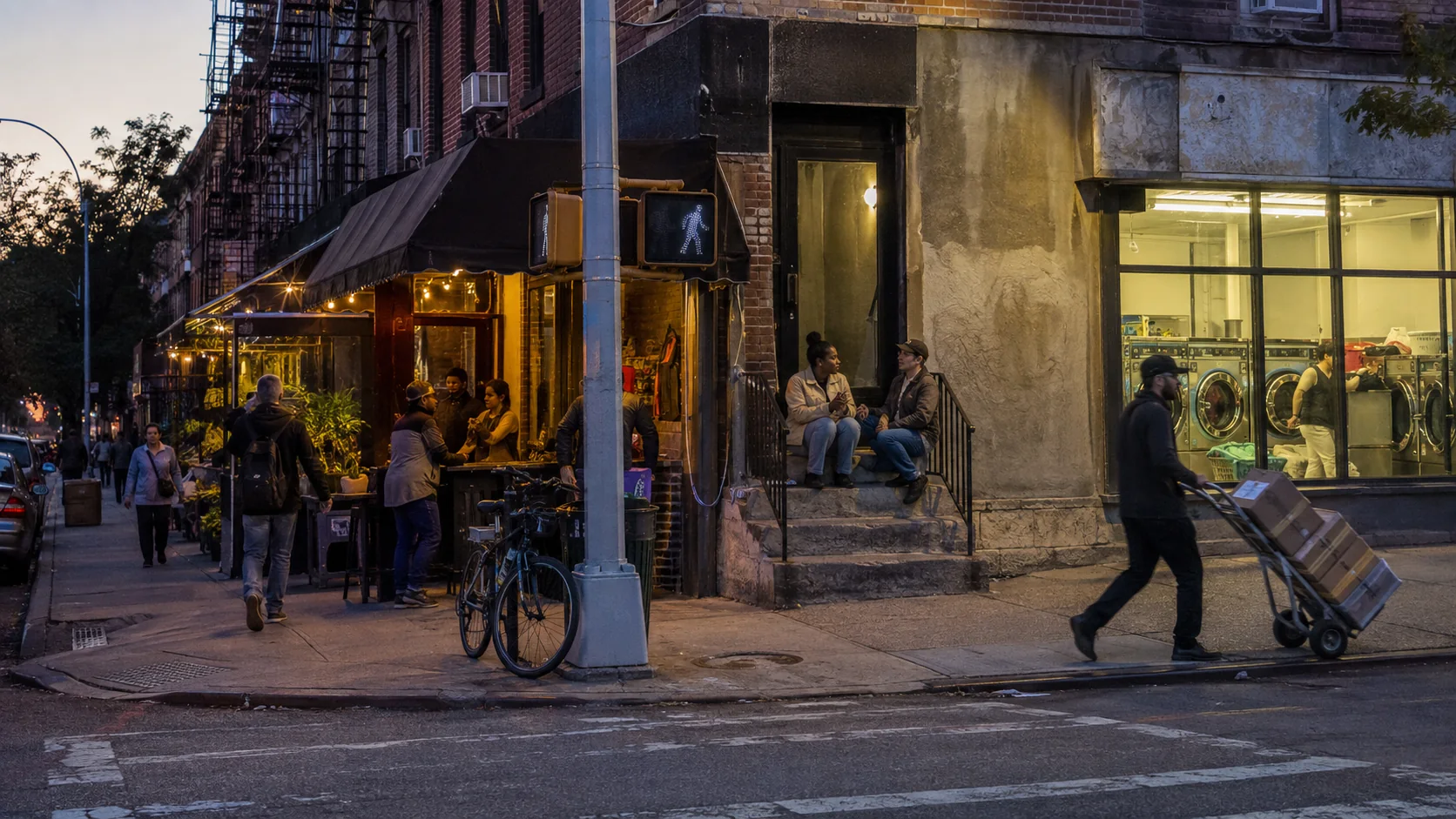
Movies teach people to recognize New York quickly. A yellow cab enters the frame. Steam rises. A fire escape cuts across brick. Someone carries coffee at a speed that suggests the city charges by the minute.
Real places rarely arrange their evidence so cleanly. A block can feel unmistakably New York without containing one landmark. The feeling comes from how space is used, how strangers negotiate, what has been repaired, what remains inconvenient, and how many lives are visible without becoming fully known.
Asking what makes a place feel like New York is risky because the answer can become a collection of clichés. Noise, grit, hustle, attitude. Those words describe performance more often than place.
The stronger signals are ordinary and specific.
A place is used before it is viewed
Movie sets exist for the camera. New York spaces exist for residents, workers, deliveries, transit, children, customers, sanitation, emergencies, and weather before a visitor decides they are beautiful.
That use leaves marks. A doorway has instructions taped at eye level. The good chair in a small shop has been repaired. A planter redirects foot traffic. A counter carries objects arranged by habit rather than design.
The place feels real because function has edited appearance.
Sound creates boundaries the eye cannot see
A train under the street, a bus braking, music from a car, kitchen ventilation, bells on a shop door, school dismissal, construction, conversation, and the sudden quiet after traffic moves all shape a block.
Sound tells a person when a place changes. A commercial street at noon is not the same street after gates close. A park beside a highway carries two environments at once.
Cinema can reproduce these sounds. It rarely reproduces their unpredictability.
Density produces small negotiations
New Yorkers share limited space with practiced adjustment. One person turns sideways in a narrow aisle. A stroller and delivery cart negotiate the curb. Riders redistribute around a crowded train door.
These interactions are not always polite. They are still forms of collective problem-solving.
A place feels like New York when private intention keeps meeting other people’s private intention and the day continues.
Memory remains after the sign changes
A new business may occupy a space people still call by the old name. A restaurant table sits where a pharmacy counter once stood. A luxury building uses a piece of industrial architecture as branding.
The city contains these overlapping maps. Longtime residents remember what disappeared. New residents build attachments to what replaced it.
Coverage should not decide that only one period was authentic. It should record who had access, who benefited, and what was lost in the transition.
Imperfection is not a costume
Exposed brick, distressed metal, old signage, and mismatched furniture can be designed to produce city credibility. Sometimes the materials are genuinely old. Sometimes a new space has paid to look worn.
Neither choice determines whether the place works. A staged imperfection becomes embarrassing when it is used to sell an idea of neighborhood toughness while excluding the people associated with that history.
Real wear comes with maintenance problems, accessibility issues, and cost. It should not be romanticized from a comfortable distance.
Public and private life sit close together
Apartment windows face elevated tracks. Restaurants place tables beside busy sidewalks. Stoops create a threshold where household and street overlap.
That proximity produces the visual intimacy people associate with New York. It also creates privacy obligations. A view into someone’s life is not permission to document it.
The cinematic moment belongs to the person living it before it belongs to the observer.
Light follows the street, not the schedule
Tall buildings create sudden shade. Reflections move across windows. Elevated structures make daylight feel artificial. Storefront lighting becomes important before sunset on one side of the block.
This uneven light can make an ordinary walk feel composed. The effect lasts minutes and has no interest in whether a camera is ready.
Noticing it requires slowing down, which is different from asking the city to perform.
Food and retail create repeated contact
A place begins feeling rooted when people return. The same coffee order, newspaper, haircut, grocery item, or repair creates recognition.
Businesses give a street rhythm through opening hours, deliveries, regular customers, and workers who know what changed since yesterday.
A beautiful space without repeat use may feel like a set because nobody has had time to build ordinary memory inside it.
Transit makes distance emotional
Two neighborhoods can be geographically close and psychologically far because no direct train connects them. A station closure changes the shape of the night. A ferry ride turns a commute into a view.
New Yorkers understand place partly through travel time and transfer difficulty. The phrase “all the way over there” carries a personal map.
Movies compress travel. City life is often defined by the part they remove.
Weather reveals the operating system
Rain finds bad drainage. Snow narrows sidewalks. Heat changes which side of the street people choose. Wind accelerates around certain corners.
The city adapts through umbrellas, salt, improvised coverings, open hydrants where permitted, fans, awnings, and complaints.
A place feels lived in when people know its weather behavior.
The city does not owe a timeless image
Visitors sometimes want New York to preserve the version they recognize from films. That desire can turn working neighborhoods into heritage products.
Cities need housing, accessible infrastructure, safer streets, repaired systems, and businesses that can survive. Change can improve life or displace it. The question is not whether a new building looks like New York. It is who it serves and how it joins the street.
Appearance is the shallowest part of belonging.
The cinematic feeling arrives sideways
It may happen when a train crosses above an intersection just as music escapes a store. It may be a stranger holding a door while arguing on the phone, a child watching a delivery, or light hitting a building nobody considers important.
These moments feel cinematic because cinema taught us to frame them, but the city created them without help.
New York does not feel like a movie set when it is busy being useful. It feels like New York when no single story controls the frame.
See something that needs attention? Send a correction. We review factual notes and attach meaningful updates to the article.