New York has never been quiet about games. The city has argued over chess tables in public parks, crowded around fighting-game cabinets, turned basketball courts into neighborhood theaters, and treated a good card game as a reason to stay at the table for another hour. Video games did not invent play here. They joined a city that already understood competition, performance, and spectators.
What has changed is the size and visibility of the network. The New York City gaming scene now includes independent studios, large companies, college programs, esports competitors, streamers, composers, artists, convention organizers, preservationists, and players who meet in borrowed rooms after work. A summer event may make that network easier to see, but it did not appear overnight.
This story is a map of the culture, not a claim that Borough Signal attended every 2026 gaming program. Public schedules should be confirmed with organizers before visiting. The signal here is broader: gaming in New York has moved beyond the stereotype of a solitary player and become one of the city’s most flexible creative communities.
The industry is not hiding in one neighborhood
Film has recognizable institutions. Fashion has a district in the public imagination. Broadway has a street. Gaming is harder to place because its work is scattered. A development team may be operating from a small office, a shared workspace, a campus lab, or several apartments connected online.
That dispersion can make the industry look smaller than it is. The visible moments are often tournaments and conventions, while the less visible work happens through design meetings, code reviews, voice sessions, community testing, and the long process of making a project stable enough for strangers to break it.
New York’s advantage is not cheap space or easy concentration. It is collision. A game artist can meet an animator from advertising, a theater sound designer, or a programmer working in finance. The city’s other industries keep feeding the medium.
Indie games fit the city’s scale
Independent game development is often described with romantic language about tiny teams and pure creative freedom. The reality includes limited budgets, uncertain release schedules, contract work, and the pressure of being discoverable in an enormous global marketplace.
Still, small games can carry a strong sense of authorship. They can explore a mechanic that would never survive a large approval process or tell a story whose audience looks too narrow on a corporate spreadsheet. In New York, where people routinely make art in cramped rooms while doing other work, that model feels familiar.
The most interesting local games are not necessarily the ones that reproduce the skyline. A project can feel shaped by New York through its pace, humor, density, or understanding of how strangers share space. Place enters design in ways more subtle than landmarks.
Competitive play creates temporary neighborhoods
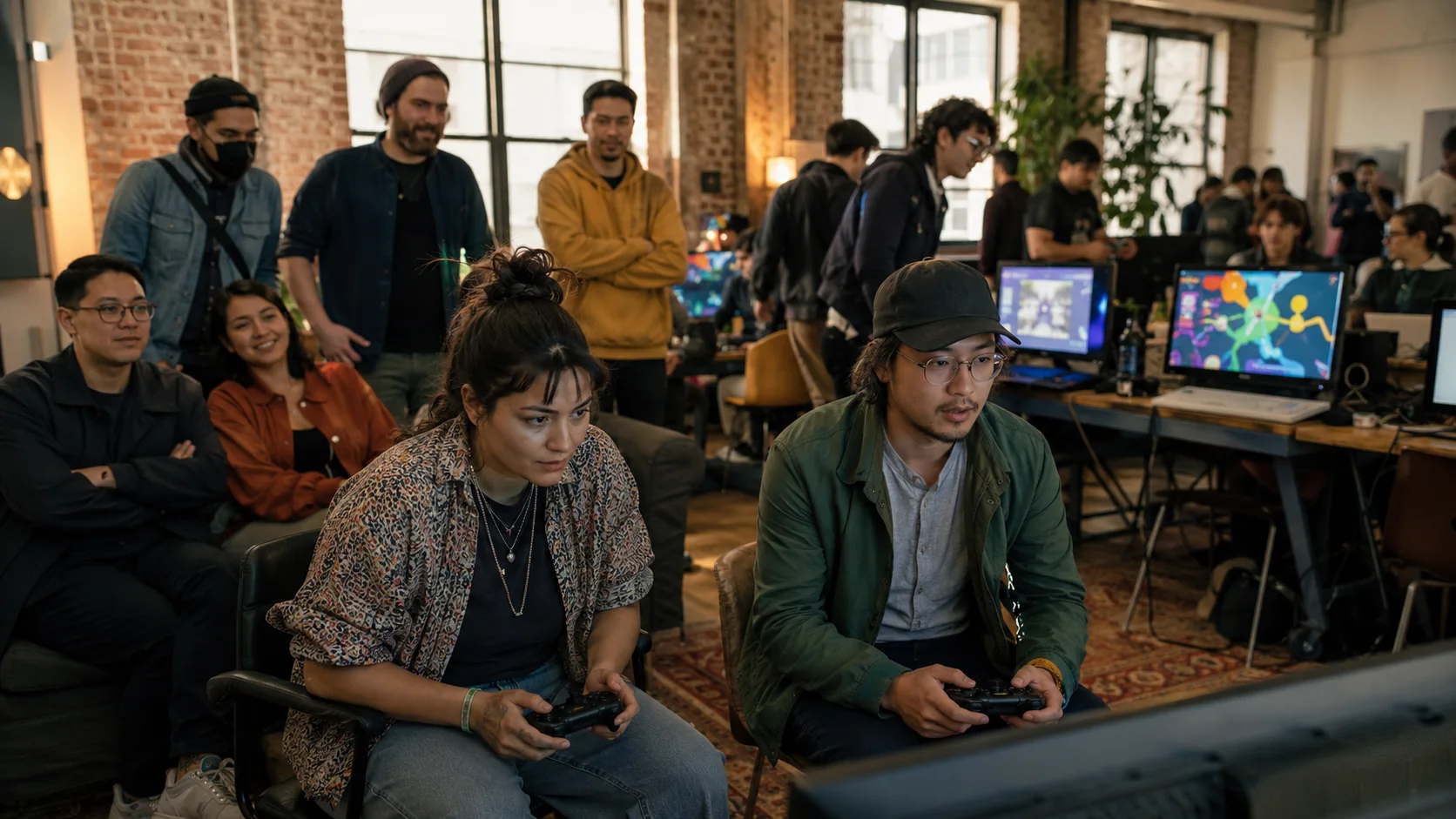
An esports event or fighting-game tournament can turn a hotel ballroom, college hall, or storefront into a temporary neighborhood. People arrive with reputations, rivalries, inside jokes, and knowledge built over years. Spectators understand small shifts that would be invisible to a newcomer.
The scene can be welcoming and intimidating at the same time. Good organizers explain formats, enforce conduct rules, and create entry points for players who are not already known. Bad ones assume community will regulate itself, which often means the loudest people set the culture.
Before attending a tournament, read the rules, registration deadline, equipment policy, and age requirements. If you are new, observe before interrupting a match. Ask where casual play happens. Most scenes want new players, but nobody enjoys explaining the bracket while they are competing.
Schools are treating games as serious work
Game design programs have expanded because students are interested and the medium now touches technology, storytelling, visual art, music, business, and education. That breadth creates opportunity, but it can also encourage vague promises about careers.
A useful program should show what students actually make, who teaches them, how team projects are managed, and what graduates do afterward. Learning a popular tool is not the same as learning design. Portfolios matter, but so do collaboration, writing, criticism, and the ability to finish a project.
Public workshops and youth programs can be especially valuable when they treat young players as creators rather than consumers. Building a small game teaches systems thinking. It also teaches the humbling lesson that an idea and a playable experience are not the same thing.
Arcades are social technology
The arcade survives because playing beside another person feels different from matching with an anonymous account. Cabinets create posture, sound, and a small public stage. Even people waiting for a turn become part of the experience.
New York arcades have changed form over the years. Some emphasize retro machines. Others combine games with bars, food, prizes, rhythm play, or competitive scenes. The strongest spaces know what kind of room they want to be. A random collection of machines is not automatically a community.
Check current hours, age policies, pricing, and machine availability before traveling. Games break. Businesses change. A nostalgic list written five years ago is not a reliable 2026 guide.
The audience is larger than the stereotype
The old picture of a gamer was always incomplete. People play on consoles, computers, phones, handheld systems, tablets, and public machines. They play deep strategy games for years and short narrative games during one subway ride. They play with family, with coworkers, with viewers, and alone.
That variety matters for coverage. A city gaming story should not be limited to expensive hardware or professional competition. Accessibility design, mobile storytelling, game preservation, tabletop crossover, and community moderation all shape who gets to participate.
It also matters who gets to make the games. Hiring, mentorship, credit, pay, and workplace culture affect which stories reach players. Celebration without labor reporting gives only half the picture.
What to watch next
The New York City gaming scene does not need to become the next Silicon Valley to matter. It can develop on its own terms, drawing from the city’s art schools, performance culture, technical workforce, immigrant communities, media companies, and stubborn habit of gathering in person.
Watch for small showcases where developers can put unfinished work in front of real players. Watch colleges and libraries that offer creation tools rather than only competitions. Watch organizers who build safer, clearer spaces. Watch the games that do not look like obvious New York stories but could only have been made by people shaped by this city.
The scene is bigger than many New Yorkers think because it does not announce itself from one building. It appears wherever people make rules, test them, break them, and invite someone else to play.
See something that needs attention? Send a correction. We review factual notes and attach meaningful updates to the article.