New York likes to describe itself as the city that never sleeps. That phrase does a suspiciously good job of avoiding the obvious follow-up question: who, exactly, is staying awake?
Somebody is cleaning the train. Somebody is working the hospital desk. Somebody is restocking the corner store, preparing food, checking a building, driving a bus, washing dishes, answering a call, or finishing a delivery while the rest of the neighborhood debates bedtime.
The night shift is not an aesthetic. It is labor. Often difficult labor, performed by people whose schedules rarely get celebrated with the same enthusiasm as the city’s after-hours entertainment.
The quiet hours are full of work
Walk through a neighborhood late enough and the sounds change. Conversations thin out. Shop gates come down. Traffic settles, at least by New York standards.
But behind the windows still glowing, work continues. A diner prepares the next order. A building employee watches the entrance. A healthcare worker takes a break before another round. Transit staff keep a complicated system moving.
This story is not a reported profile of one real worker or a claim about a specific business. It is an acknowledgment of a pattern visible across the city: ordinary nighttime life depends on people whose effort is easy to overlook.
A cup of coffee can be practical kindness
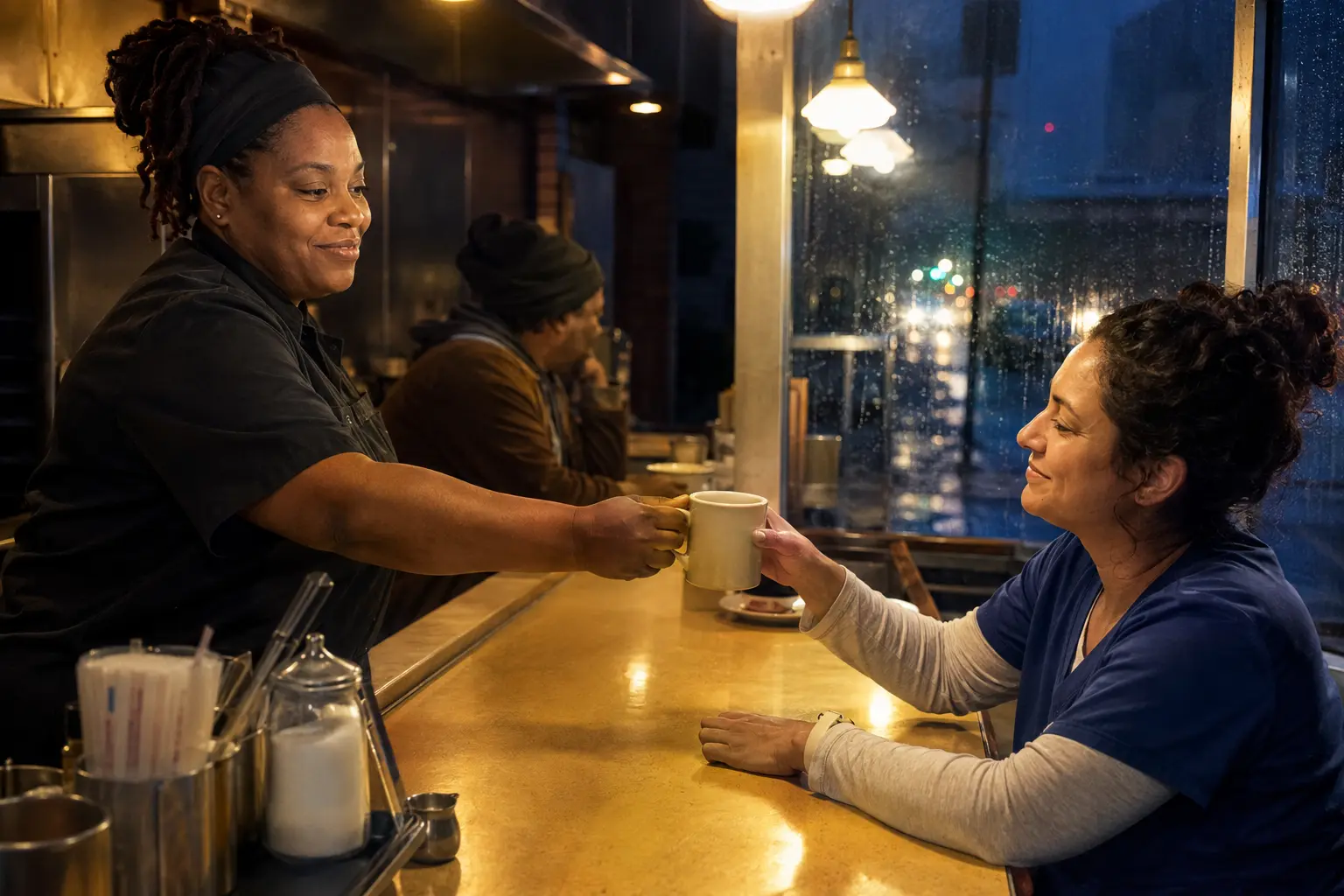
At the right hour, a hot drink is not an accessory. It is warmth, routine, a brief pause, or a reason to stand still for five minutes.
The person serving it may be tired too. That makes the small exchange more interesting. Two people meet in the overlap between their responsibilities, and for a moment the city feels less indifferent.
No invented conversation is necessary. A familiar greeting, a clearly stated order, a clean counter, and a little patience can do the job.
Kindness is not always dramatic enough to become a story. It still changes the room.
Not every night worker has a choice
Some people prefer overnight schedules. Others take available shifts because of wages, caregiving, school, transportation, or limited alternatives.
It is important not to romanticize exhaustion. Working late can involve disrupted sleep, safety concerns, unreliable transit, childcare challenges, and limited access to services available during ordinary business hours.
If someone’s job supports the rest of the city, the appropriate response is not merely admiration. It includes respect for fair working conditions, clear communication, and the reality that workers need rest and support too.
Individual experiences vary. Broad claims about wages, schedules, or safety should be grounded in reliable evidence rather than assumptions.
The businesses still open are part of the infrastructure
A late-night diner, pharmacy, deli, or laundromat may appear unremarkable during the day. At night, it can become one of the few places where someone can eat, buy a necessary item, sit briefly, or ask for help.
Hours change, so check a business’s own current information before relying on it. Do not assume every neighborhood has the same access to late-night services.
Support the places you use. Pay fairly, follow posted rules, respect closing times, and avoid treating staff as available for endless conversation just because fewer customers are present.
The lights staying on do not mean the people working stopped needing boundaries.
Transit is part of the story too
Getting home after an overnight shift can be more complicated than daytime commuters realize. Routes may change, service intervals can be longer, and accessibility or safety concerns may shape the entire trip.
Use the MTA’s current service information ↗ when planning late travel. If you are meeting someone after a shift, ask what timing and transportation actually work for them.
Practical consideration matters more than abstract praise.
What customers can do
Be clear. Be patient. Do not arrive at closing and insist the rules bend around your convenience. Tip appropriately where tipping applies. If you notice a mistake, address it without escalating a tired person’s night into a public performance.
If you are socializing late, remember that nearby residents may be sleeping and workers may be trying to keep the space calm. New York can hold energy and courtesy at the same time.
Recognize that the person on the other side of the counter has a life outside the shift. You do not know what kind of day—or night—they have already had.
A neighborhood feels safer when people know one another
Familiarity is not a substitute for public safety systems, and no individual worker should be expected to protect an entire block. Still, recognizable faces can make a street feel less anonymous.
The regular customer knows which shop stays open. The worker recognizes someone coming from the hospital. The building employee notices when a person needs directions.
These tiny forms of connection do not solve structural problems. They can make the hours between midnight and morning feel more human.
Read more about the people behind New York’s daily routines and city-life stories that slow down long enough to notice.
Morning does not arrive by itself
By the time the first commuters begin complaining about coffee, other people have already completed half a day’s work.
The city does not stay awake because sleeplessness is charming. It stays awake because workers make it possible.
Remember that the next time a late-night window looks welcoming. Someone turned on those lights, kept the place running, and made it a little easier for another New Yorker to get through the night.
If you know someone working overnight, ask what support would actually help rather than guessing. It may be a ride, a meal, a quieter daytime environment, or simply understanding that their sleeping hours deserve the same respect as everyone else’s. Employers, neighbors, and customers all influence whether late work feels manageable. No single gesture fixes the structural challenges. Still, ordinary consideration can reduce some of the unnecessary friction. The city owes its overnight workers more than a romantic slogan. At minimum, it owes them the recognition that the lights remain on because people are doing real jobs.
See something that needs attention? Send a correction. We review factual notes and attach meaningful updates to the article.