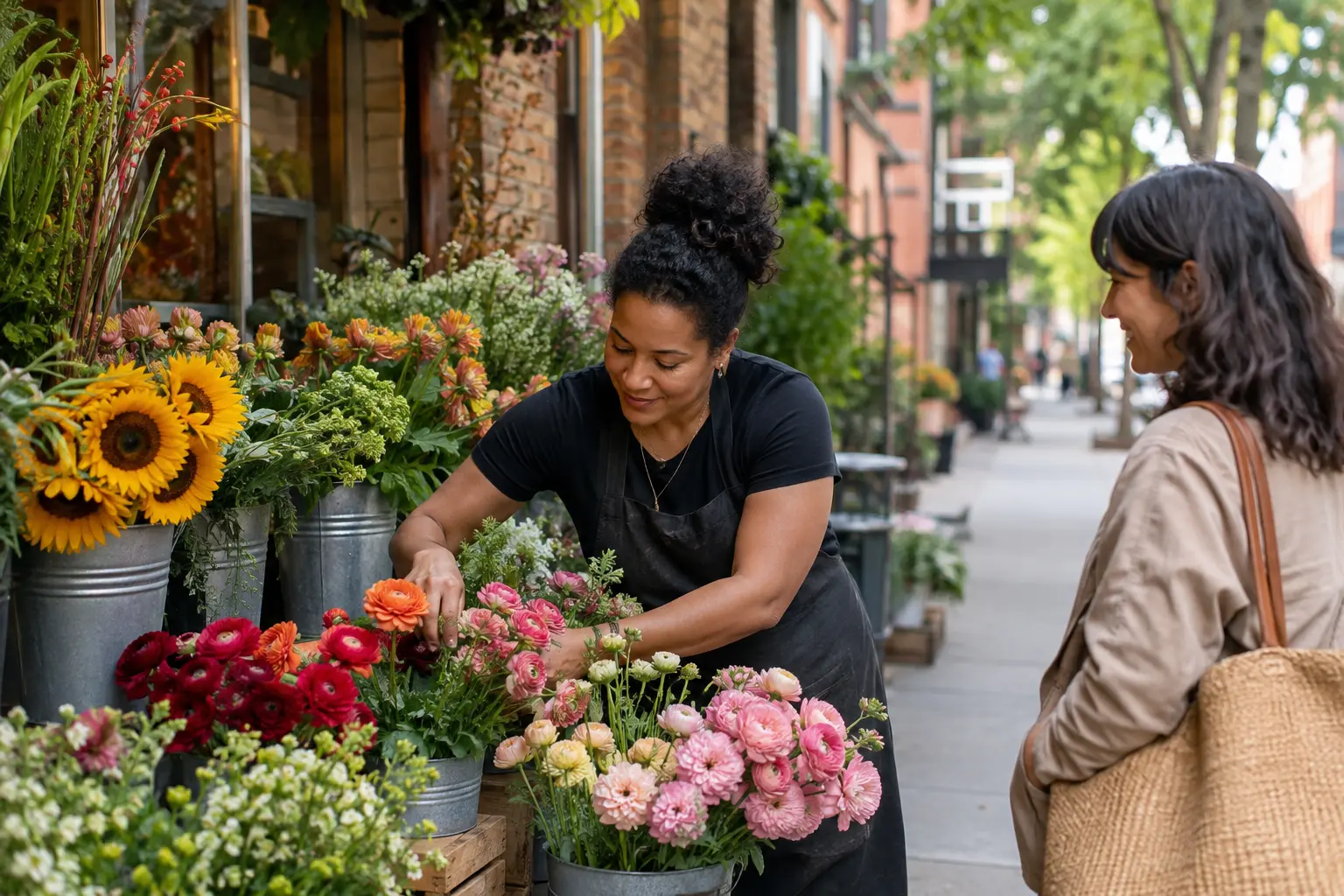
Some people can tell what kind of week you are having by the way you say hello. Not in a mystical way. More in the way that comes from seeing the same neighbors every morning and remembering that the woman from upstairs usually buys white tulips unless something important has happened.
Every New York neighborhood has people like this. The florist is one of them.
This is not a claim about a specific shop or an interview that did not happen. It is about a kind of city presence most of us recognize: the person who stands behind a counter surrounded by flowers and somehow understands that the bouquet is almost never just a bouquet.
Flowers are rarely about flowers
They are for an apology that needs more than a text. A birthday somebody almost forgot. A new apartment that still smells like cardboard and uncertainty. A hospital visit. A first date. A goodbye nobody knows how to phrase.
They are also for Tuesday, which may be the most convincing reason of all.
An independent neighborhood florist sees the full emotional range of a city without requiring anyone to explain the plot. You can walk in looking uncertain, point at something bright, name a budget, and leave carrying proof that small care still has a physical shape.
The best florist does not assume every customer wants a dramatic arrangement. Sometimes one strong stem, properly wrapped, is the entire right answer.
Knowing a neighborhood is skilled work
Local shops learn the rhythms of the blocks around them. School dismissal changes the afternoon. Weddings create certain weekend patterns. Graduations, memorials, apartment moves, and religious holidays all affect what people look for.
That knowledge is not automatic. It is built by showing up, listening, adjusting inventory, remembering names when possible, and treating regular customers like people rather than transaction histories.
A florist may also know which flowers hold up in overheated apartments, which arrangements travel well on the subway, and which plants are less demanding for someone whose previous houseplant experience ended in a small funeral.
Those details rarely make a business seem glamorous. They do make it useful.
The budget conversation should not feel embarrassing
Flowers can be expensive. Rent can be expensive. Being alive in New York occasionally feels like a subscription you forgot to cancel.
There should be no shame in saying what you can spend. A good shop works within the number or tells you kindly what is realistic. One beautiful bunch may be better than an elaborate arrangement assembled from anxiety.
Seasonal flowers can sometimes offer better value, though availability and prices change. Ask what is fresh, what will last, and whether the shop can suggest something simple. If you are buying for someone with pets, check safety rather than assuming every plant or bloom is harmless.
Care does not become more sincere because the receipt is larger.
Why independent storefronts change a block
A flower shop contributes more than merchandise. Buckets on the sidewalk add color to an ordinary walk. A window changes with the seasons. People pause, look, chat, and remember there is a reason to slow down.
That does not mean every neighborhood business survives on charm alone. Independent operators deal with commercial rent, supplier costs, staffing, weather, delivery logistics, and competition from services designed to make local knowledge look disposable.
If a shop matters to you, the most useful support is practical: buy what you can afford, recommend it honestly, respect staff time, and ask before taking photographs. A small storefront should not have to become an attraction before it earns its place on the block.
Explore more New York neighborhood coverage to see how everyday businesses shape the city around them.
Let people tell you what they know
There is a particular kind of arrogance in asking an expert for advice and then immediately explaining their own job back to them.
If someone works with flowers every day, let them suggest an alternative when your first choice is unavailable. Tell them whether the arrangement needs to travel, how long it should last, and whether the recipient has preferences or allergies. A little context is more useful than pretending you know the names of six flowers you absolutely cannot identify.
The resulting bouquet might not resemble anything saved on your phone. That can be the best part.
Personal attention does not always look polished. Sometimes it looks like a quick adjustment, a better stem pulled from the back, or a warning that a particular bloom will not survive a hot commute.
The small ceremony of bringing something home
Flowers do not fix a difficult week. They do not pay bills, solve housing problems, or make a delayed train arrive.
They can, however, interrupt the feeling that every object in your apartment needs to be productive. They can make a kitchen table look inhabited. They can remind someone that they were thought about when they were not in the room.
That is not trivial. Cities are held together by practical systems and small gestures, and it becomes harder to live well when we pretend only the systems count.
The people selling those gestures understand something about the neighborhoods around them. They witness the celebrations, losses, reconciliations, new beginnings, and ordinary afternoons that never make the news.
Somebody is keeping track in a kinder way
Not with a spreadsheet. Not with a loyalty algorithm. Just through the imperfect human practice of recognizing familiar faces.
Maybe the person behind the counter remembers your mother likes sunflowers. Maybe they know you always buy something small before visiting a friend. Maybe they simply notice you looked tired and choose the brightest color in the bucket.
That is a form of attention New York still has room for.
Read more stories about the people who make this city work, and next time you pass an independent flower shop, look at what the sidewalk is doing around it. Chances are the whole block feels a little more awake.
Strong Signal
Worth making the trip.
See something that needs attention? Send a correction. We review factual notes and attach meaningful updates to the article.